

When Nick and I started plotting Random the Book, a memory from my childhood influenced our thinking.
When I went to the library as a child, two things excited me: Asterix the Gaul books and a peculiar publishing phenomenon called Jackdaw folders.
Whilst I loved the adventures on the pages of Asterix graphic novels, the enchanting thing about Jackdaw folders was the spirit of curiosity they forced upon a reader. Rather than a series of pages, these A4-ish-sized folders contained several facsimile artefacts about a particular subject, and (bar a small booklet explaining some of the content) it was up to the reader to piece together a narrative.
I love this idea. I’m also practical and pragmatic, and such a mixed-format offer would be very expensive to produce without scale.
As a result, we parked the idea, other than conspiring to have a book written so that the chapters could be read in any (random) order. We would then also record how we built a machine to enable readers to generate a random reading order for their experience (whilst still allowing traditional linear reading).
That shaped much of our initial planning. However, as I found from the last time I tried to write a book, the traditional structure of 70,000+ words split into a dozen or more chapters is challenging. I’m used to writing in short form, from (as was) a tweet up to a blog article. Book writing (and reading too often) feels like an exercise in generating words to fill a predetermined space. I often feel that writers should be more determined to get to the bloody point, particularly with non-fiction writing.
When I started to flounder, two inputs from my marvellous network of friends and acquaintances helped me break out of what was becoming constraining but not creative.
The first was from Lisl Macdonald, who pointed me at a book written in 1949 by JB Priestley called “Delight.” It contains 114 short essays about things that delighted him, from Waking to smell bacon (105) to Orchestras tuning up (89) to Knowing a poet (60) picking a handful at random (appropriately).
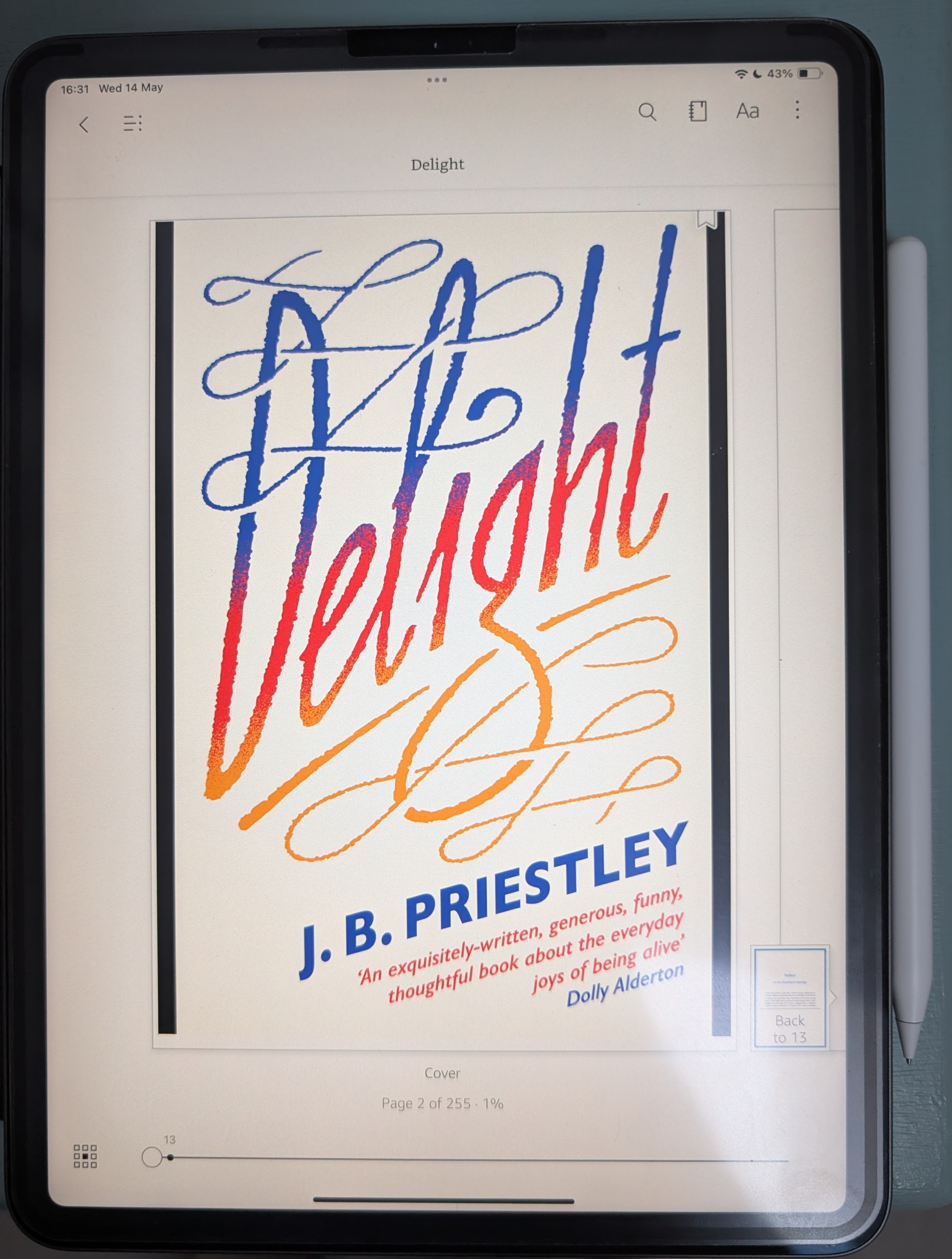
The essays are self-contained, making me realise that we didn’t have to limit myself to the 12 or so chapters. Indeed, the opportunity to randomise the reading order could become far greater with a similar structure to Delight, while playing much more to our preferences for writing (although navigating dozens of short essays in a book in random order might be a bit painful).
The second was Tamsin Fox-Davies pointing me at an episode of the podcast The Allusionist that told the story of John Finnemore’s The Researcher’s First Murder. Listen to the podcast for the full and fascinating story, but suffice to say John’s “book” is a box containing around 100 postcards, with a picture on one side and a fragment of a story on the other. It’s a murder mystery, far cleverer than anything I could imagine, but it’s a format Nick and I are leaning towards.
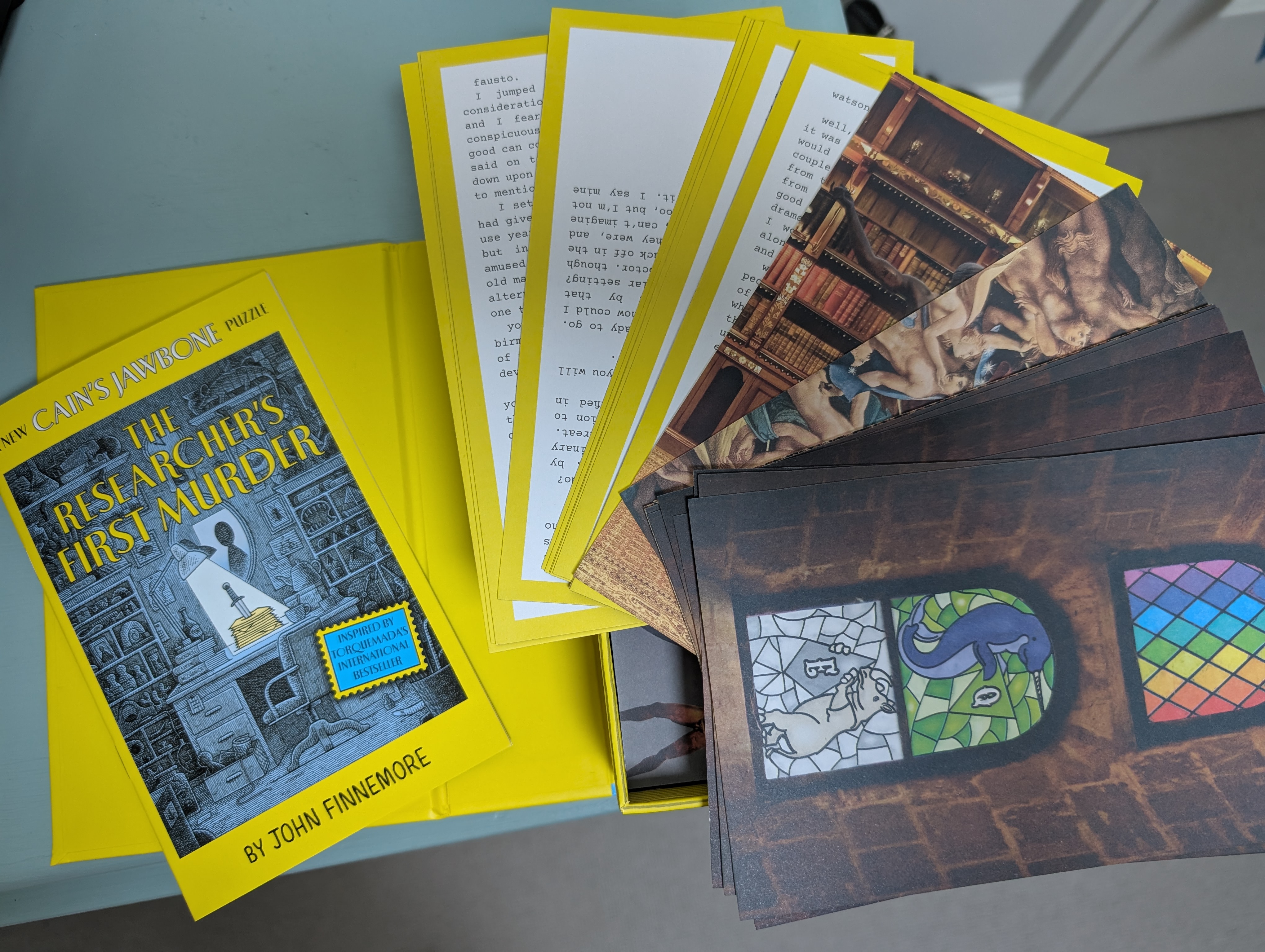
And so Random the Book will be unbound. 120 or so A5 postcards, picture on one side, short story about randomness on the other. This will allow us to play into the Jackdaw way of thinking, but in a way that has enough uniformity to make production costs reasonable. It will enable readers to play with randomness with the content about randomness. And it also allows us to play with ideas like Random As A Service which would enable people to subscribe to packages of randomness over time.
A website will accompany the “book” and contain further links, tools, and other content to extend the experience.
I’d love to hear what you think about this latest madcap scheme – we’ve got about 100 ideas for cards already, ranging from the history of ERNIE, the machine that picks the winners of the Premium Bonds lottery in the UK, to how the Athenians picked people for civic duty, to how randomness allows you to stay alive every single day.
Below are three AI interpretations about how the thing might look that bring to mind Arthur Dent’s description of the drinks served on the Heart of Gold: a liquid that is “almost, but not quite, entirely unlike tea”.

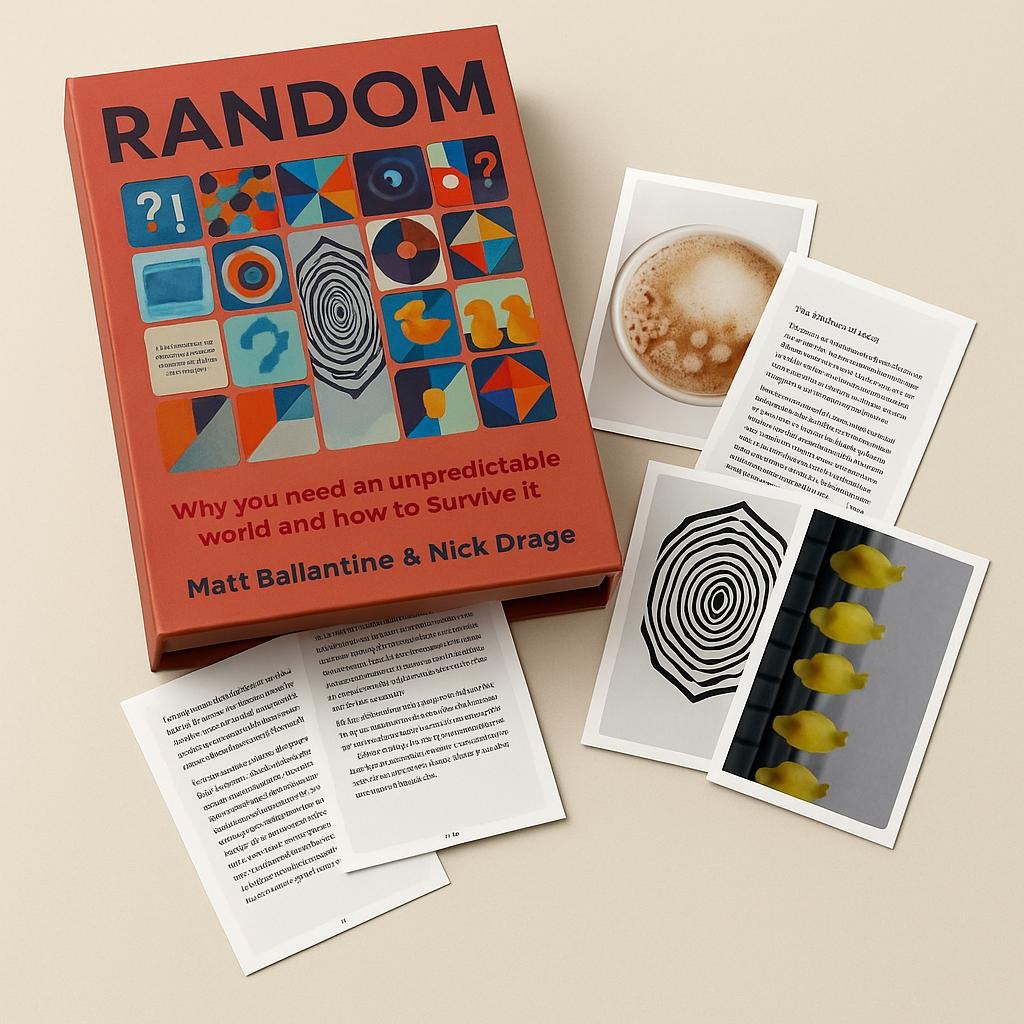
If you know a good graphic designer to help us on the project, do let me know.

 Random the Book
Leave a reply to davegray Cancel reply