Questions for you:
- When you use the word “random” in everyday conversation, which of the five definitions are you actually reaching for? And when someone else uses it, do you check which meaning they intend?
- Has the word’s derogatory sense — a “rando,” someone who is unwantedly or inexplicably present — shaped how you think about randomness more broadly? Is there a connection between dismissing unexpected people and undervaluing unexpected ideas?
- The statistical definition means something quite specific and sometimes quite likely. Does knowing that help or hinder your intuitive understanding of when something is genuinely random?
Organisational applications:
Shared vocabulary and the cost of ambiguity: When a team uses the word “random” to mean five different things — and shifts between those meanings without signalling which is intended — misunderstanding follows. Someone proposing a “random sample” means something statistically precise; someone describing a strategy as “a bit random” is probably criticising it as incoherent.
The word’s unusual semantic range makes it more prone to this kind of confusion than most. The practical response is not to police vocabulary but to develop the habit of asking what someone means when the stakes of the misunderstanding are high. This is the same discipline the Sherman Kent vocabulary story advocates: shared meaning before shared decisions.
The derogatory sense and its organisational consequences: The story notes that “random” as a noun — a rando, someone unexpected and unwelcome — carries a particular social charge. In professional contexts, the same instinct surfaces as resistance to outside perspectives, unexpected participants, or unplanned inputs. The person who shows up in a meeting from a different part of the organisation, the customer whose use case doesn’t fit the expected profile, the colleague who asks a question that seems to come from nowhere — all of these can be experienced as disruptive randoms.
But the stories elsewhere in the book consistently argue that unexpected inputs are where serendipity, novel combinations, and genuine surprises come from. The instinct to exclude the random is comprehensible; the cost of indulging it is reduced exposure to things you did not know you needed.
Precision in a word that resists precision: The statistical definition of random — equal probability across all outcomes — is the most precise, but it is also the one most frequently violated in practice. Processes described as random are often not random in this sense: sampling that is systematic rather than probabilistic, selections that are arbitrary rather than equiprobable, shuffles that produce patterns rather than genuine mixing.
The word’s cultural looseness provides cover for this imprecision. When randomness is doing genuine analytical or fairness work — in sampling, in selection, in audit — it is worth being explicit about whether the process meets the statistical definition or merely feels random. The gap between the two is where a surprising amount of organisational risk, both in measurement and in perceived fairness, tends to accumulate.
Further reading
On language, meaning, and how words evolve:
The Etymologicon: A Circular Stroll Through the Hidden Connections of the English Language by Mark Forsyth. Forsyth’s account of how English words acquire contradictory and unexpected meanings over time is the linguistic companion to the story — useful for understanding why “random” has such a genuinely unusual semantic range.
How to Lie with Statistics by Darrell Huff. Huff’s older but still sharp account of how statistical terms are misused covers the specific problem of “random” being applied to non-random processes, which is the practical consequence of the word’s ambiguity.
On the statistical meaning and what genuine randomness requires:
Struck by Lightning: The Curious World of Probabilities by Jeffrey Rosenthal. Rosenthal’s accessible treatment of probability and randomness is the most direct complement to the story’s statistical definition — useful for anyone who wants to move from the cultural to the mathematical sense of the word.
The Drunkard’s Walk: How Randomness Rules Our Lives by Leonard Mlodinow. Mlodinow’s account of how randomness operates in practice — and how frequently what appears random is not, and vice versa — covers the gap between the precise definition and everyday usage that the story identifies.
On shared vocabulary, communication, and precision in uncertainty:
Superforecasting: The Art and Science of Prediction by Philip Tetlock and Dan Gardner. Tetlock’s argument for precise probability language — numbers rather than vague qualitative terms — is the applied version of the story’s closing observation: when the word is doing analytical work, its imprecision is a practical problem, not just an interesting curiosity.
Noise: A Flaw in Human Judgement by Daniel Kahneman, Olivier Sibony and Cass R. Sunstein. The chapters on communication and shared meaning cover how much variability in organisational decisions results from people using the same words to mean different things — the core problem the story’s five definitions illustrate.
About the image
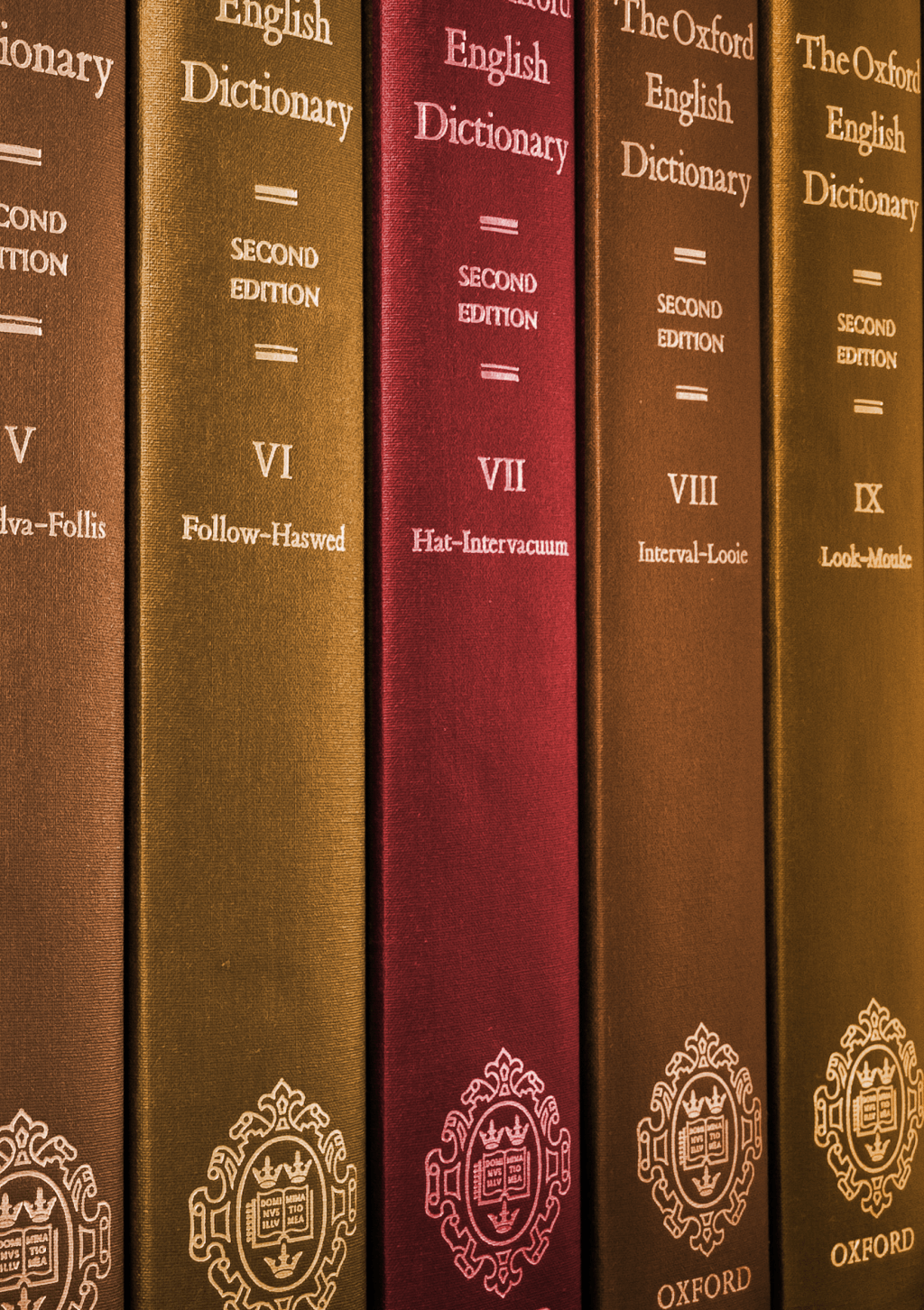
Some volumes of the Oxford English Dictionary https://commons.wikimedia.org/wiki/File:OED2_volumes.jpg
Photo montage by Matt Ballantine, 2026
 Random the Book
