Questions for you:
- What processes, systems, or standards do you or your organisation use primarily because they were adopted early, rather than because they are the best available option?
- What processes, systems, or standards do you or your organisation use primarily because that’s how a previous version of the process or system or standard works, rather than because they are the best available option now?
- Can you think of a moment when your organisation evaluated switching to something better but concluded the switching costs were too high? How was that cost calculated, and did it account for the cumulative cost of staying with the inferior system? How long was the cumulative cost counted for?
- Where might you or your organisation currently be accumulating the kind of lock-in that will make future change much more expensive than it needs to be?
Organisational applications:
Early adoption as an unplanned commitment: The QWERTY story is not really about keyboards; it is about how organisations accumulate commitments they did not consciously make. No organisation decided to adopt QWERTY permanently — they simply adopted it first, and each subsequent investment in training, equipment, and documentation made switching progressively more expensive.
Most organisational technology and process choices follow the same pattern. The system that happens to be available and adequate at a critical moment becomes entrenched, not because it is best, but because everything that has been built around it represents sunk investment that would be written off by switching. Recognising this dynamic is the precondition for managing it: before any significant investment in a current system is made, it is worth asking whether that investment makes the system harder to leave and whether that commitment is worth making deliberately rather than accidentally.
The gap between switching cost and staying cost: Path dependence persists because switching costs are visible and immediate, while staying costs are diffuse and accumulate slowly. The calculation that concluded the efficiency benefits of Dvorak did not outweigh the switching costs was technically correct at the time of evaluation, but it ignored the compounding costs of continuing with an inferior system over decades of use.
Organisations face this asymmetry constantly: the cost of migrating to a new system is concrete and appears in a project budget, while the cost of continuing with the current system is distributed across thousands of hours of unnecessary friction and does not appear on any single line. Making the costs of staying explicit, rather than treating the status quo as costless, tends to produce more accurate comparisons.
Using transition moments to escape lock-in: The story implies that the moments when lock-in is most escapable are transitions — when the underlying constraint that justified the original choice has changed, when a significant upgrade is already planned, or when external circumstances force change regardless. QWERTY could have been replaced when typewriters gave way to electric machines, or when computers replaced typewriters, or when touchscreens replaced physical keyboards.
Each transition was a moment when the cost of changing the layout was lower than usual, and each was missed. Organisations that identify their own transition moments — platform migrations, reorganisations, leadership changes, regulatory shifts — and use them deliberately to exit suboptimal path-dependent arrangements tend to escape lock-in more successfully than those that wait for the perfect moment that never arrives.
This does add another factor to an existing transition, but evaluate the costs and risks, and be brave.
Further reading
On path dependence, lock-in, and technological standards:
The Tipping Point: How Little Things Can Make a Big Difference by Malcolm Gladwell. Gladwell’s account of how small early advantages tip into dominant positions covers the same dynamic as the QWERTY story in social and cultural contexts, with useful complementary examples.
The Black Swan: The Impact of the Highly Improbable by Nassim Nicholas Taleb. Taleb’s discussion of Extremistan and winner-takes-all dynamics covers the network effects that make early technology advantages self-reinforcing, explaining why QWERTY’s early lead translated into permanent dominance rather than gradual displacement.
On switching costs, sunk costs, and organisational inertia:
Thinking, Fast and Slow by Daniel Kahneman. Kahneman’s treatment of loss aversion and the sunk cost fallacy explains the cognitive mechanisms that make path dependence so durable: the pain of abandoning existing investment systematically outweighs the rational calculation of future costs and benefits.
Noise: A Flaw in Human Judgement by Daniel Kahneman, Olivier Sibony and Cass R. Sunstein. The chapters on organisational decision-making cover how status quo bias, the tendency to favour existing arrangements over alternatives, compounds path dependence by making the comparison between current and alternative systems systematically unfair to the alternative.
On innovation, standards, and why better technologies sometimes lose:
Against the Gods: The Remarkable Story of Risk by Peter L. Bernstein. Bernstein’s historical account of how risk management practices developed includes material on how arbitrary early conventions became entrenched standards, providing broader context for the QWERTY pattern.
Antifragile: Things That Gain from Disorder by Nassim Nicholas Taleb. Taleb’s argument for avoiding fragile commitments that cannot be unwound under stress is the prescriptive counterpart to the QWERTY cautionary tale: build systems that preserve optionality rather than locking in early choices.
Interactive exhibit
See some of the alternatives to QWERTY that have tried (and some failed) over the years…
https://experiments.randomthebook.com/QWERTY
About the image
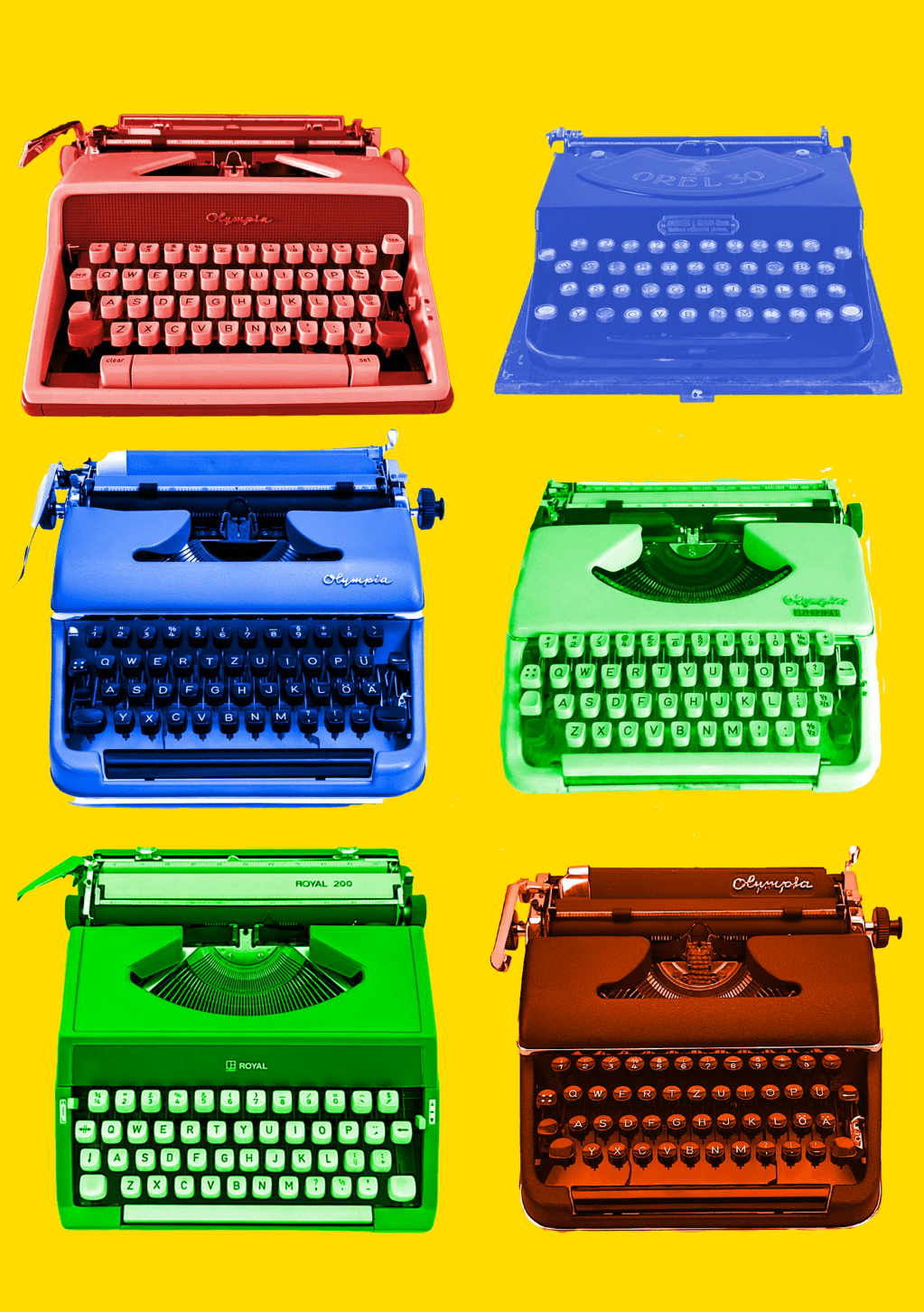
A collection of typewriters culled from the Internet.
Photo montage by Matt Ballantine, 2026
 Random the Book