Questions for you:
- When your team does creative or strategic work, what mechanisms do you use to introduce inputs from outside your existing frame of reference? Are those mechanisms systematic or ad hoc?
- Have you ever discounted a randomly generated or arbitrarily combined idea before properly testing it? What drives that instinct?
- What would it take for your team to treat a mechanical or physical random process as a legitimate part of a professional workshop, rather than a gimmick?
Organisational applications:
Constraint as the thing that makes random combination useful: The story makes an observation that is easy to miss: the first iteration of the Creativator, with only the scenario wheel, produced weaker results than the version with the business model wheel added. Unconstrained randomness generates combinations, but not necessarily useful ones.
The constraint layer is what forces cognitive work — the question “how could a broker model work in a world where consumers become citizen activists through low-cost sensors?” requires genuine thinking in a way that a single random prompt does not. This is a practical design principle for any randomised creative technique: the number of constraint dimensions matters, and adding a second or third constraint category tends to significantly improve output quality. The sweet spot is enough constraint to force connection-making without so much constraint that combinations become trivially obvious.
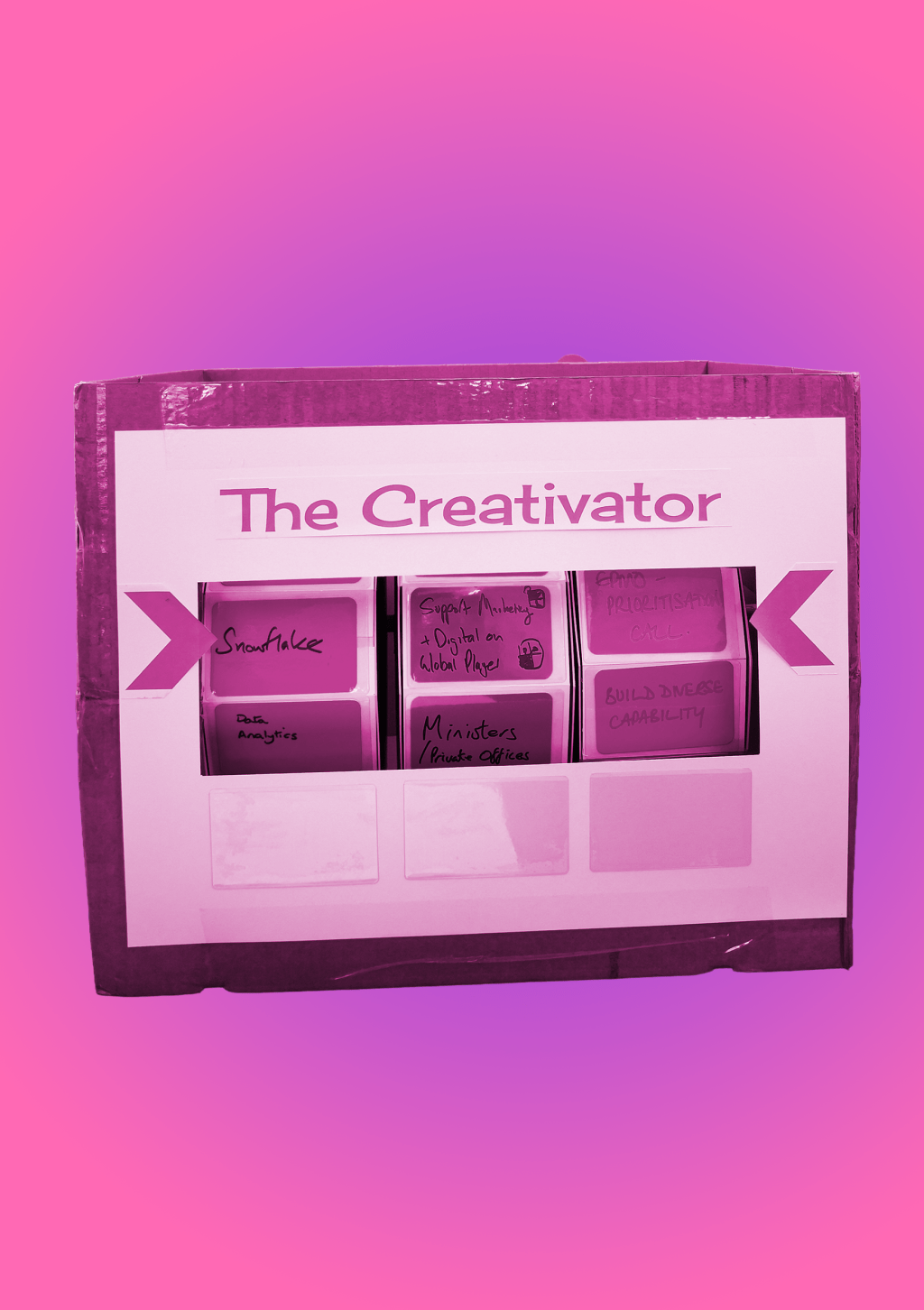
Physical presence as legitimacy: The story’s most distinctive observation is that the physical device changed how participants related to the random process. Spinning wheels with clacking marbles felt like a proper process in a way that a digital randomiser or a card draw did not.
This is not irrational: the collective, observable, mechanical nature of the process distributed ownership of the random selection across the group rather than concentrating it in whoever was facilitating. When everyone watches the wheels settle, everyone is equally committed to working with the result. Digital tools that produce random outputs do not create the same shared experience. For workshops where buy-in to the random combination is important, the investment in physical presence is not superficial.
Volume as a feature, not a bug: The team generated five ideas per spin and ran enough spins to produce thirty refined ideas over a day. This is an important design choice. The Creativator works not because any single combination is guaranteed to be good but because a sufficiently large volume of combinations statistically ensures that some will be worth developing.
Treating each spin as producing one definitive idea misuses the technique. The correct frame is that randomness generates raw material for human evaluation and selection — the marbles produce the combinations, but the team decides which ones have legs. Organisations that use randomised creative techniques most effectively treat volume generation and quality filtering as separate phases, rather than expecting each random combination to be immediately usable.
Further reading
On randomness and constraint in creative processes:
Oblique Strategies by Brian Eno and Peter Schmidt. The most direct point of comparison: a different approach to the same underlying problem of breaking creative deadlock through randomised constraint. Worth considering alongside the Creativator because the two techniques differ meaningfully — Oblique Strategies provides a single provocative instruction while the Creativator combines three categories — and the differences matter for which context each suits.
Algorithms to Live By: The Computer Science of Human Decisions by Brian Christian and Tom Griffiths. The chapters on explore/exploit trade-offs provide a formal framework for understanding when generating many random combinations is more efficient than iterating on known good options — which is the implicit logic behind running thirty Creativator spins in a day.
On combination, creativity, and the role of constraints:
Combinatorics and Creativity — the Wikipedia article on creativity covers the combinatorial theory of creativity (the idea that novel ideas arise from combining existing concepts), which is the theoretical basis for what the Creativator is doing, even if the story doesn’t name it explicitly.
The Medici Effect by Frans Johansson. Johansson’s account of how breakthrough ideas emerge at the intersection of different fields and disciplines is the organisational management literature’s version of the Creativator logic: forced combination of disparate domains produces more novel outputs than working within a single field.
On group creativity, facilitation, and the legitimacy of process:
Gamestorming: A Playbook for Innovators, Rulebreakers, and Changemakers by Dave Gray, Sunni Brown, and James Macanufo. A practical handbook for designed creative processes in group settings, covering the importance of physical and ritual elements in making creative techniques feel legitimate to participants — directly relevant to the story’s observation about the Creativator’s tombola aesthetic.
Interactive exhibit
If you have the time, you can build your own Creativator with the instructions at: https://mmitii.mattballantine.com/2019/07/04/the-creativator/
But if you don’t have the time, there’s an interactive version here: https://experiments.randomthebook.com/creativator/
About the image
The original. I think building The Creativator is one of the highlights of my consulting career.
Photo montage and photo by Matt Ballantine, 2026
 Random the Book