Questions for you:
- Can you identify a significant opportunity you or your organisation missed because the necessary conditions were present but not simultaneously? What would it have taken to recognise that in the moment?
- Are there assets in your life or organisation, systems, relationships, spaces, or capabilities that were built for one purpose and are now underused, which might have value in an entirely different context?
- How does your organisation currently treat apparent failures or abandoned projects? Do they get cleared away, or is there a practice of reviewing them for residual value?
Organisational applications:
Recognising the convergence window: The High Line story is specifically about multiple independent conditions aligning at a particular moment, and the critical importance of having someone present to recognise and act on that alignment. The campaign succeeded because two people happened to walk past the structure at the right time, with the right disposition, and with enough persistence to hold the opportunity open until other conditions caught up.
Organisations can create structural conditions for this kind of recognition without being able to manufacture the convergence itself: maintaining peripheral awareness of dormant assets and stalled initiatives, building relationships across disparate teams that would need to converge for an opportunity to crystallise, and having a small number of people whose role explicitly includes watching for alignment rather than executing against a predetermined plan.
The value of assets that do not fit current plans: The story notes that abandoned infrastructure possesses qualities that new construction cannot replicate. This is a point about the value that accumulates in things built for one purpose that outlast it. Organisations habitually undervalue such assets because they are evaluated against their original purpose rather than their potential repurposed value.
Unused office space, legacy systems with embedded institutional knowledge, relationships with lapsed customers, and dormant partnerships all carry potential that is invisible when measured against the original plan. Periodically auditing what the organisation holds that does not fit the current strategy, with a specific question about what it might enable in combination with other factors, is a low-cost way of expanding the surface area available for opportunistic convergence.
Persistence as the mechanism that holds the window open: The story is careful to note that the High Line campaign seemed doomed to failure for most of its twenty-nine years. What made the eventual convergence possible was that the citizens behind it maintained the initiative across multiple cycles of political and economic conditions, keeping the option alive until other factors aligned. This is a specific organisational capability: the ability to sustain low-level commitment to an idea or initiative across periods when conditions are not favourable, without either abandoning it or escalating it prematurely into a major resource commitment.
Most organisations are poor at this because their planning and budgeting cycles force binary decisions, invest or cut, and leave no structured space for dormant persistence. Creating explicit mechanisms for maintaining small, cheap, ongoing commitments to ideas whose time has not yet come is a practical response to the convergence logic described in the story.
Further reading
On opportunity windows, stream convergence, and timing:
Agendas, Alternatives and Public Policies by John W. Kingdon. Kingdon’s multiple streams framework is the most precise analytical account of the mechanism the High Line story illustrates: opportunities emerge when problem streams, solution streams, and political streams converge, and the role of the entrepreneur is to recognise and exploit those windows rather than to force convergence through planning.
The Tipping Point: How Little Things Can Make a Big Difference by Malcolm Gladwell. Gladwell’s account of how small contextual changes combine with persistent underlying conditions to produce sudden shifts in outcomes covers similar territory from a different angle, with useful examples of convergence dynamics in social and cultural contexts.
On serendipity, luck surface area, and creating conditions for convergence:
The Luck Factor by Richard Wiseman. Wiseman’s research on how people who experience more fortunate outcomes differ behaviourally from those who do not is directly relevant: the High Line citizens were not lucky in a passive sense; they maintained the behaviours, persistence, openness, and network-building, that made them available to seize the window when it opened.
Antifragile: Things That Gain from Disorder by Nassim Nicholas Taleb. Taleb’s concept of optionality, maintaining exposure to positive random convergences while limiting downside, is the most formal available framework for the kind of low-cost persistent commitment the High Line campaign exemplified.
On urban randomness, unplanned value, and the limits of rational planning:
The Death and Life of Great American Cities by Jane Jacobs. Jacobs’s foundational argument that urban vitality emerges from the complexity and apparent disorder of mixed-use organic development is the intellectual background to the High Line story, and makes the broader case for why random combinations of factors produce outcomes that rational planning cannot replicate or predict.
About the image
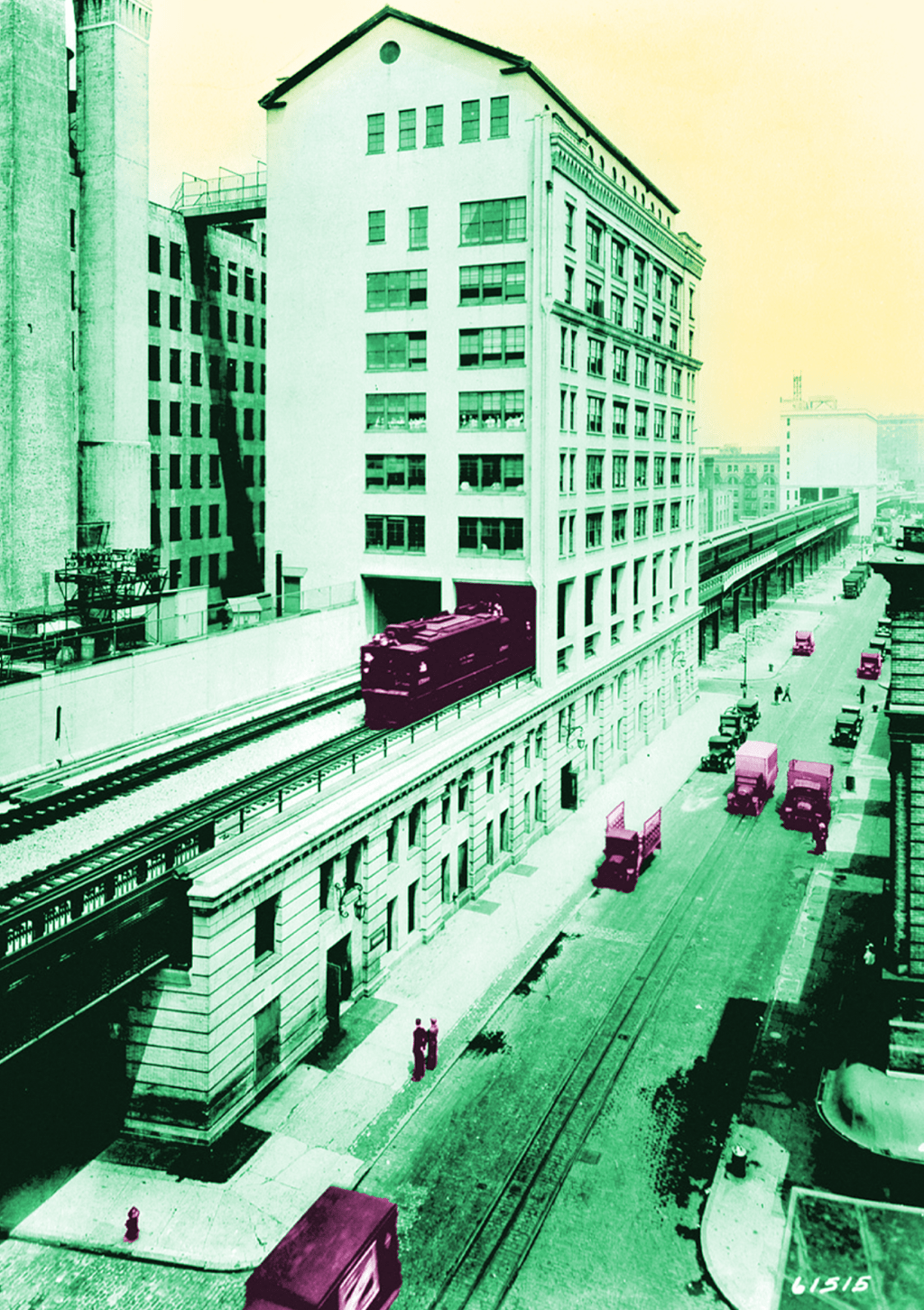
An image of the High Line in its years as a goods railway.
Photo montage by Matt Ballantine, 2026, Photo Public Domain
 Random the Book