Questions for you:
- How many of the significant decisions in your life were genuinely the product of deliberate rational choice, and how many were shaped by habit, social expectation, or arbitrary circumstance?
- Are there decisions you keep deferring or avoiding because the process of choosing feels paralysing? Can you use a randomisation method to pick an option that you’ve already identified as acceptable? Can you do that right now?
- Where in your work do you operate on autopilot, following established patterns not because they are best but because they are familiar? Is that optimal, or just comfortable?
Organisational applications:
Using randomness to surface hidden assumptions in decision-making: The novel’s central core is to make visible what is usually invisible: the degree to which everyday choices are shaped by convention, habit, and social expectation rather than genuine deliberation. The dice do not actually make better decisions; they expose how arbitrary many apparently reasoned decisions already are.
Organisations can deliberately apply a version of this. Randomly reassigning meeting attendees, rotating which team leads a project, or selecting between pre-qualified options by lot rather than by further analysis are all ways of testing whether the reasoning behind established patterns holds up when the patterns are disrupted. The discomfort these interventions produce is informative, but if the outcome of a randomly selected decision is as good as the carefully chosen one, that is worth knowing – if only because of the resources that can be saved for use elsewhere.
Randomness as a tool for breaking decision paralysis: The story notes that using random methods to make choices can break people out of predictable patterns and force them to explore territories they would not consciously select. This is the legitimate organisational application of dice-rolling logic: not surrendering all judgement to chance, but using randomness to force a first move when the cost of continued deliberation exceeds the cost of an imperfect decision.
Brainstorming processes that randomly assign topics, priority-setting exercises that use random ordering to surface alternatives that analytical ranking suppresses, and project retrospectives that randomly select which issues to examine, all use this mechanism. The point is not that the random choice is better, but that in genuinely ambiguous situations the marginal value of further deliberation is often close to zero, and the cost of delay is not.
The question of responsibility and accountability under randomness: The novel raises a question that the organisational context makes concrete: if a decision was randomised, who is accountable for the outcome? The protagonist’s dice-rolling is partly an attempt to evade moral responsibility, and organisations face a version of this when they delegate decisions to algorithms, processes, or committees, thereby diffusing accountability without improving decision quality.
There is a meaningful difference between using randomness to break deadlock among options that have already been evaluated, which preserves accountability, and using it to avoid making a judgement at all, which does not. The dice work as a creative tool precisely when they operate within a field of pre-selected options that someone has already taken responsibility for generating.
Further reading
The novel itself:
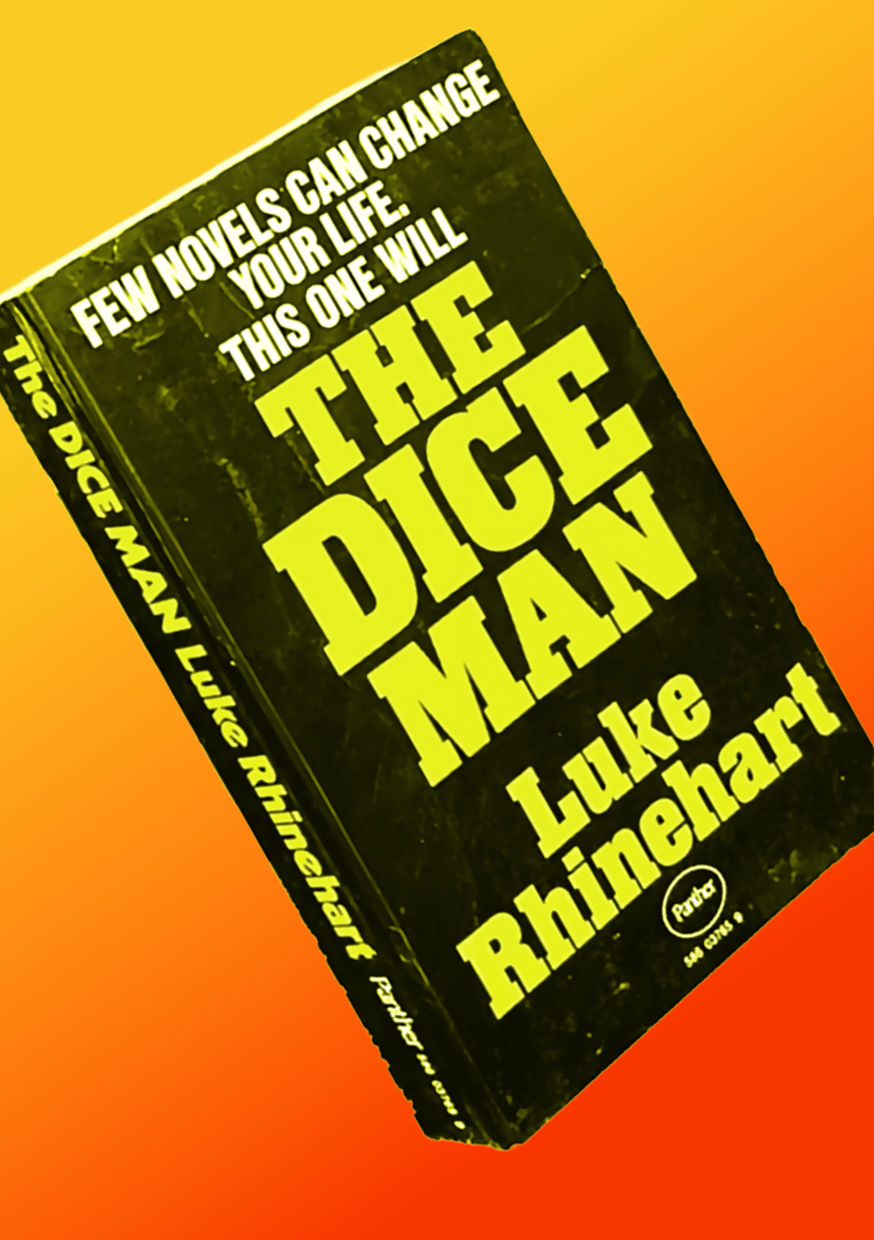
The Dice Man by Luke Rhinehart. The obvious starting point. Worth noting that the novel is deliberately provocative and not a practical manual: Rhinehart uses the dice premise to explore questions about identity, conformity, and moral responsibility that go considerably further than any organisational application would warrant.
On free will, habit, and the arbitrariness of conventional choice:
Thinking, Fast and Slow by Daniel Kahneman. Kahneman’s account of how most decisions are made by automatic cognitive processes rather than deliberate reasoning is the empirical underpinning for the novel’s intuition that consciously “chosen” decisions are often less chosen than they appear.
The Power of Habit by Charles Duhigg. Duhigg’s account of how habits form and can be disrupted is relevant to the novel’s implicit argument that much of what passes for decision-making is actually habit execution, and that introducing randomness is one way to break the loop.
On deliberate randomness in creative and professional practice:
Oblique Strategies by Brian Eno and Peter Schmidt. The most direct practical application of dice-man logic in a professional creative context: a set of randomly drawn instructions designed to break habitual working patterns. The connection to the book’s own Oblique Strategies story is direct.
Algorithms to Live By: The Computer Science of Human Decisions by Brian Christian and Tom Griffiths. The chapters on randomisation and explore/exploit trade-offs provide a formal framework for understanding when introducing randomness into decision processes is genuinely rational rather than merely contrarian.
Interactive exhibit
Live your life like the Dice Man at https://experiments.randomthebook.com/thediceman/
About the image
One of the paperback editions of the novel.
Photo montage by Matt Ballantine, 2026
 Random the Book