Questions for you:
- Can you think of a situation outside gambling where a near-miss made you more determined to try again, rather than less?
- Where in your working life might someone be engineering the appearance of almost-success to keep you engaged or motivated?
- How would your behaviour change if the odds in every system you interact with were displayed as clearly as they are on a roulette wheel?
Organisational applications:
Recognising engineered near-misses in performance management: The slot machine near-miss works because it triggers the same neural response as an actual win, encouraging continued effort despite no change in the underlying probability. Performance management systems can produce an equivalent effect unintentionally or deliberately. Targets set just above current performance, feedback framed consistently as “almost there,” and milestone structures that always leave one more step to complete all create the psychological conditions the story describes.
This is not always cynical; incremental goal-setting has genuine motivational value, but it is worth asking whether the near-miss experience in your organisation reflects genuine proximity to success or is a structural feature of target design. The distinction matters because one provides useful feedback and the other serves as a mechanism for sustaining effort regardless of actual progress.
Transparency of odds as a design principle: The story draws a direct contrast between roulette, where the house edge is visible and calculable by anyone who looks at the wheel, and slot machines, where the mathematics is concealed behind graphics and manufactured excitement. The same spectrum exists in organisational decision-making. Promotion processes, funding allocation, and sales competitions vary enormously in how legibly their actual odds are communicated to participants.
Organisations that obscure the real probability of success in competitive internal processes, whether by design or neglect, reproduce the slot machine dynamic: participants invest effort based on a felt sense of proximity to winning that may bear little relation to their actual chances. Making the real odds visible is not demotivating in itself; it allows people to make informed decisions about where to direct their efforts.
Applying near-miss psychology carefully in product and service design: The story notes that near-misses trigger dopamine responses and encourage continued engagement, and that this is deliberately exploited in gambling products. The same mechanism is available to product designers working in entirely legitimate contexts: progress bars, achievement systems, loyalty schemes, and onboarding flows all routinely use near-miss logic to sustain engagement.
The ethical question the story implicitly raises is whether the near-miss reflects genuine proximity to something the user values, or whether it is purely a retention mechanism decoupled from real benefit. Designers who can answer that question honestly are in a better position to build systems that serve users rather than simply extract time from them.
Further reading
On gambling psychology and the near-miss effect:
Addiction by Design by Natasha Dow Schüll. An ethnographic study of machine gambling in Las Vegas, examining how slot machines are engineered to produce a state of continuous play. The most detailed account available of how near-miss programming and return-to-player mathematics are deliberately designed around human psychological vulnerability rather than genuine chance.
The Psychology of Gambling by Michael B. Walker. A systematic examination of the cognitive distortions that sustain gambling behaviour, including the near-miss effect, the illusion of control, and the gambler’s fallacy. Useful for understanding why the mechanisms the story describes are so reliably effective.
On cognitive biases in risk and reward assessment:
Against the Gods: The Remarkable Story of Risk by Peter L. Bernstein. A history of humanity’s attempts to understand and quantify risk, from ancient dice to modern derivatives. Provides context for why the engineered opacity of modern gambling machines represents a deliberate regression from the transparency that probability theory makes possible.
Thinking, Fast and Slow by Daniel Kahneman. Kahneman’s treatment of loss aversion and the emotional weight of near-misses explains the neural mechanism the story describes, and why the dopamine response to almost-winning is a predictable feature of human cognition rather than an individual weakness.
On the ethics of persuasive and engagement design:
Hooked: How to Build Habit-Forming Products by Nir Eyal. A product designer’s framework for creating habitual engagement, which inadvertently serves as a clear account of how near-miss logic migrated from gambling machines into mainstream consumer technology.
Irresistible: The Rise of Addictive Technology and the Business of Keeping Us Hooked by Adam Alter. Covers the deliberate application of gambling psychology to social media, games, and apps, making the connection between the slot machine mechanics the story describes and the broader digital attention economy.
About the image
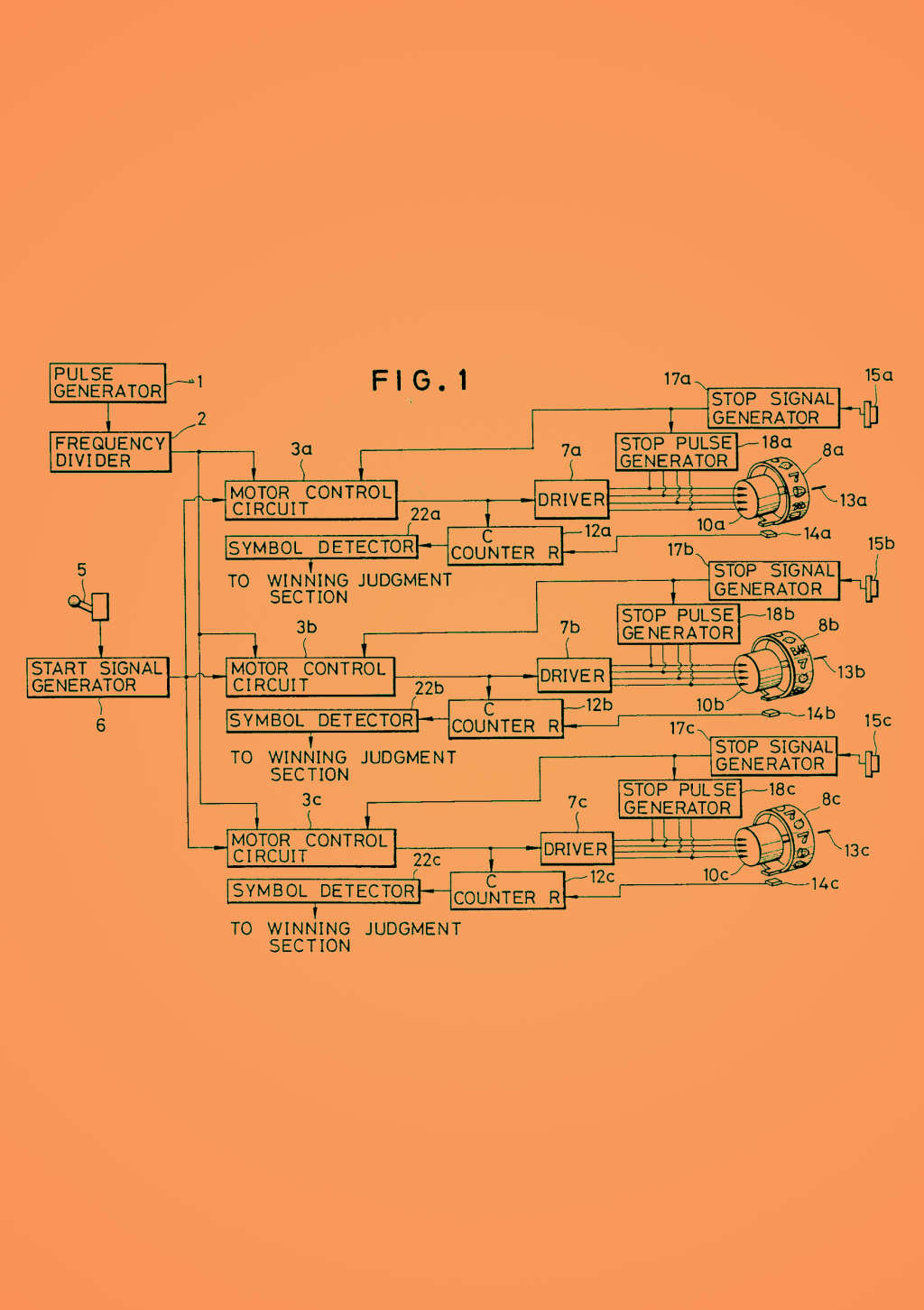
The schematic is taken from a patent for a device to stop the wheels of a slot machine: https://patents.google.com/patent/US4772022
Montage by Matt Ballantine, 2026
 Random the Book