Questions for you:
- Do you believe the university you attended (or didn’t) was a fair reflection of your ability, or were there factors outside your control that shaped the outcome?
- If you’re honest, how much of what you attribute to merit in your own career might more accurately be attributed to circumstance?
- Where else in your life do you accept a disguised lottery while insisting it’s a meritocracy?
Organisational applications:
Auditing selection processes for concealed arbitrariness: The story’s argument about university admissions applies directly to how organisations hire. Most structured recruitment processes claim to be meritocratic — scored interviews, competency frameworks, standardised assessments — but the research is consistent: beyond a threshold of competence, selection decisions are heavily influenced by subjective impression, cultural fit judgements, and interviewer bias.
The question worth asking is not whether to introduce a lottery, but whether the current process is honest about its own arbitrariness. Tracking which candidates are rejected at which stage, and by whom, often reveals patterns that undermine the meritocratic claim. If the differences between shortlisted candidates are genuinely marginal, acknowledging that openly — and perhaps randomising final selection among those candidates — would at least be intellectually honest.
Using random selection to build diverse leadership pipelines: One concrete application of the story’s logic is in talent development, not final hiring. Rather than selecting high-potential employees through nomination processes that systematically favour those already visible to senior leaders, organisations can randomly sample from all employees meeting a minimum performance threshold for development programmes, stretch assignments, and leadership exposure.
This is distinct from arbitrary promotion: the threshold still exists, but the selection from within it is random. The effect is to surface people who would never have been nominated — not because they lack ability, but because they lack proximity to whoever does the nominating.
Applying sortition logic to internal decision-making bodies: The book’s story on the Irish Citizens’ Assembly is relevant here. The same principle that makes a randomly selected citizens’ assembly produce less polarised, more evidence-based outputs than an elected legislature applies, in a modified form, to internal organisational governance.
Standing committees and working groups tend to be self-selecting, leading to homogeneous thinking. Randomly rotating membership, drawing from a pool of qualified employees rather than relying on volunteers or nominations, changes who gets exposure to strategic decisions, reduces groupthink, and distributes institutional knowledge more widely. It also has the practical benefit of preventing the same people from simultaneously occupying every governance role.
Further reading
On meritocracy and its discontents:
The Tyranny of Merit: What’s Become of the Common Good? by Michael J. Sandel. Sandel’s argument that meritocracy produces hubris in winners and humiliation in losers is directly relevant to the card’s point about resistance to random selection — the resistance tells us something important about what meritocratic narratives are actually doing.
The Meritocracy Trap: How America’s Foundational Myth Feeds Inequality, Dismantles the Middle Class, and Devours the Elite by Daniel Markovits. A Yale law professor’s account of how elite education functions as a mechanism for reproducing advantage rather than selecting for ability, with detailed evidence on the arms race described in the story.
The Rise of Meritocracy by Michael Young. The seminal text, written as a satire, was by Toby Young’s father. Which has a delicious irony.
On sortition and random selection in democratic contexts:
Against Elections: The Case for Democracy by David Van Reybrouck. The clearest short case for sortition as a complement or alternative to electoral democracy, drawing on the Athenian precedent and contemporary experiments, including the Irish Citizens’ Assembly, referenced elsewhere in the book.
The Luck of the Draw: The Role of Lotteries in Decision Making by Peter Stone (Oxford University Press, 2011). A philosophical examination of when random selection is not merely acceptable but actively preferable to other decision-making methods — including in contexts where apparent meritocratic criteria are either unmeasurable or contested.
On bias in selection and the limits of structured assessment:
Thinking, Fast and Slow by Daniel Kahneman (Allen Lane, 2011). Kahneman’s chapters on expert judgement and the failure of clinical prediction are the most accessible account of why structured human selection processes consistently underperform simple algorithms — and why the confidence of selectors is largely unrelated to their accuracy.
Noise: A Flaw in Human Judgement by Daniel Kahneman, Olivier Sibony, and Cass R. Sunstein (William Collins, 2021). Extends the argument specifically to organisational selection contexts, showing that even trained assessors using the same criteria produce wildly inconsistent results — which is a strong argument for either algorithmic selection or, at the margin, randomisation.
About the image
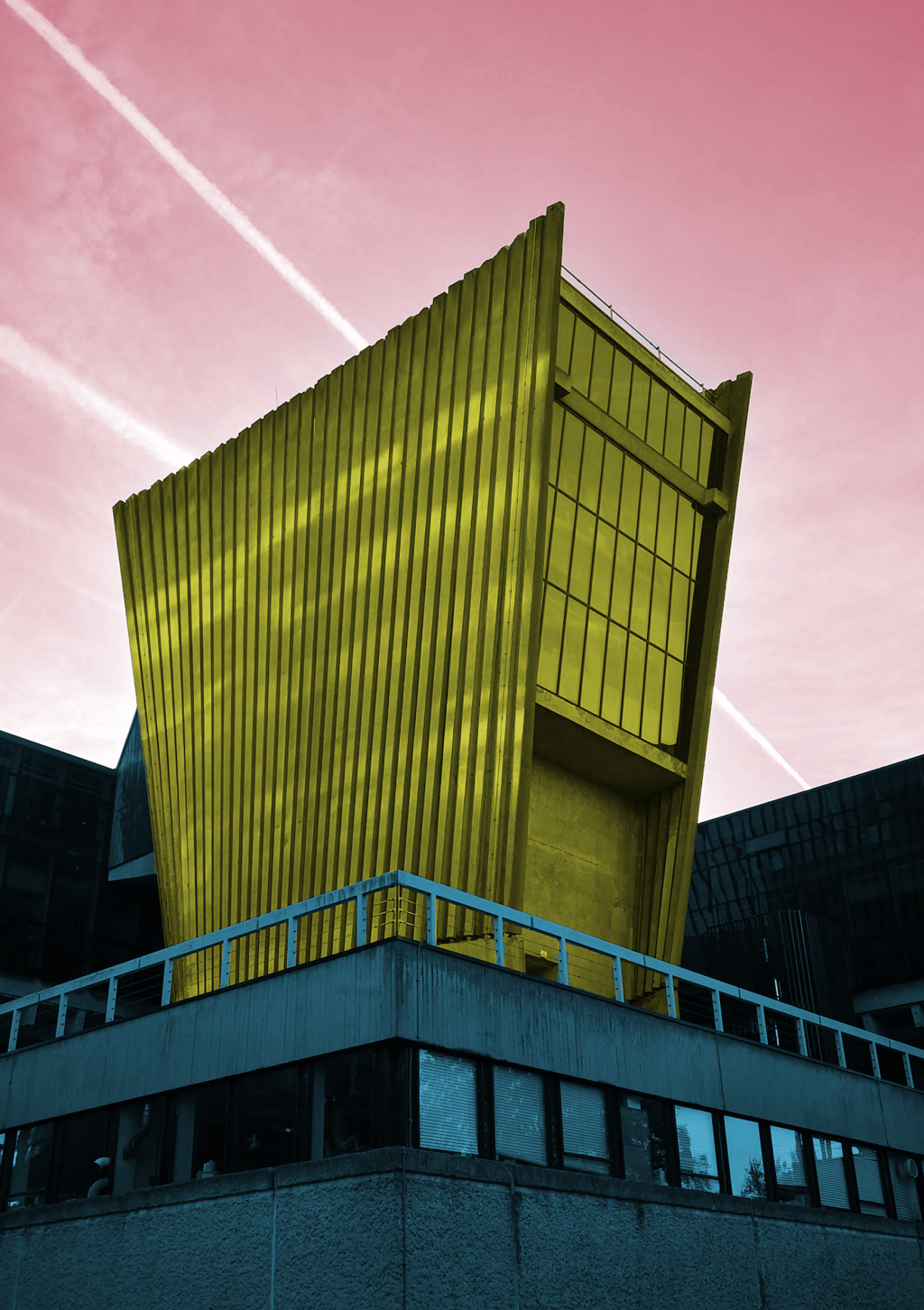
This is the Denys Wilkinson Building, a physics lab designed by Philip Dowson from Arup in 1967. This fan-shaped block contains a Van de Graaff generator. I took the photo at the impeccable Names Not Numbers conference in Oxford in 2019, organised by the wonderful Julia Hobsbawm.
Photo montage and photo by Matt Ballantine, 2026
 Random the Book