Questions for you:
- When designing simulations or exercises involving randomness, do you recognise the difference between “with replacement” (independent events like dice) versus “without replacement” (dependent events like cards)?
- Looking at how you model uncertainty, do you consider whether past outcomes should affect future probabilities, or whether each event should be independent? Does this reflect reality?
- When representing random factors in planning or training scenarios, do you consciously choose mechanics that match the real-world phenomenon – and can you justify those decisions when you need to?
- When you’re playing serious games, or even “less serious” recreational games, do you appreciate the difference? And what does that tell you about the underlying philosophy of the game, that luck evens out, or that the events being simulated are genuinely unrelated?
Questions for your organisation:
Choose random mechanics matching reality: for a game or exercise or Monte Carlo simulation, does your method of simulating a real phenomenon match it appropriately? Ensure that you’re choosing mechanics matching what you’re modelling: dice for independent repeated events (customer arrivals, equipment failures); cards for depleting irreplaceable resources (hiring from a candidate pool, allocating items from an inventory). Mismatched mechanics create misleading models.
When randomness “happens”, it affects planning: the dice outcome isn’t set until thrown – randomness occurs when it’s seen. But the card outcomes are set when they’re shuffled, and only when drawn – randomness predetermined but unknown. Choosing this correctly can help staff focus in on how to affect “luck”, equipment failures have been cited as independent events – but after a key failure do staff pay more attention, and may formally or informally carry out additional checks. Now the randomness has changed, do you modify the rolls, or have the game’s facilitator remove the next couple of “Equipment Failure” cards from the deck?
Memory in systems changes strategy: Card decks have memory – drawing an ace makes remaining aces less likely. This affects strategic planning: if hiring three specialists from a limited candidate pool, the first hire of a clear “Ace” changes the odds for subsequent hires – maybe finding those remaining ace employees by chance is reduced, do your rivals now hire more aggressively? But dice have no memory, you rolling 12 on two dice – to represent hiring an exemplary talent – makes no difference to how others will act. In this situation, are you understanding the talent pool correctly, and are your rival employers? Thinking about a system in these terms can help you grasp how it works, or, at the very least, help you determine what research you need to engage in to figure that out.
Further reading
Probability, game design, and random mechanics
The Theory of Gambling and Statistical Logic by Richard A. Epstein – mathematical analysis of games of chance including detailed explanation of with-replacement versus without-replacement probability affecting strategy.
Dice Games Properly Explained by Reiner Knizia – game designer’s explanation of how different random mechanics (dice versus cards) create different strategic environments and player experiences.
Probability Guide to Gambling by Catalin Barboianu – examines how memory (cards) versus independence (dice) affects gambling strategy, relevant to understanding when each mechanic appropriate.
Game design and simulation
Rules of Play by Katie Salen and Eric Zimmerman – comprehensive game design text including discussion of random mechanics and how choice between dice, cards, or other methods affects player experience and strategy.
Characteristics of Games by George Skaff Elias, Richard Garfield, and K. Robert Gutschera – explores how different randomness mechanics create different game characteristics, including memory effects in card-based versus dice-based systems.
The Art of Game Design by Jesse Schell – includes discussion of when to use different random mechanics based on what designer wants to represent and how memory versus independence affects player psychology.
Serious games and training simulations
Reality Is Broken by Jane McGonigal – explores how game mechanics including randomness design affect engagement and learning, relevant to serious game design requiring justified randomness choices.
Serious Games by Clark C. Abt – foundational text on using games for training and education, including discussion of representing uncertainty and random events appropriately for learning objectives.
Wargaming for Leaders by Mark Herman – explains how military and business wargames use different random mechanics to represent different types of uncertainty, fog of war, and resource constraints.
About the image
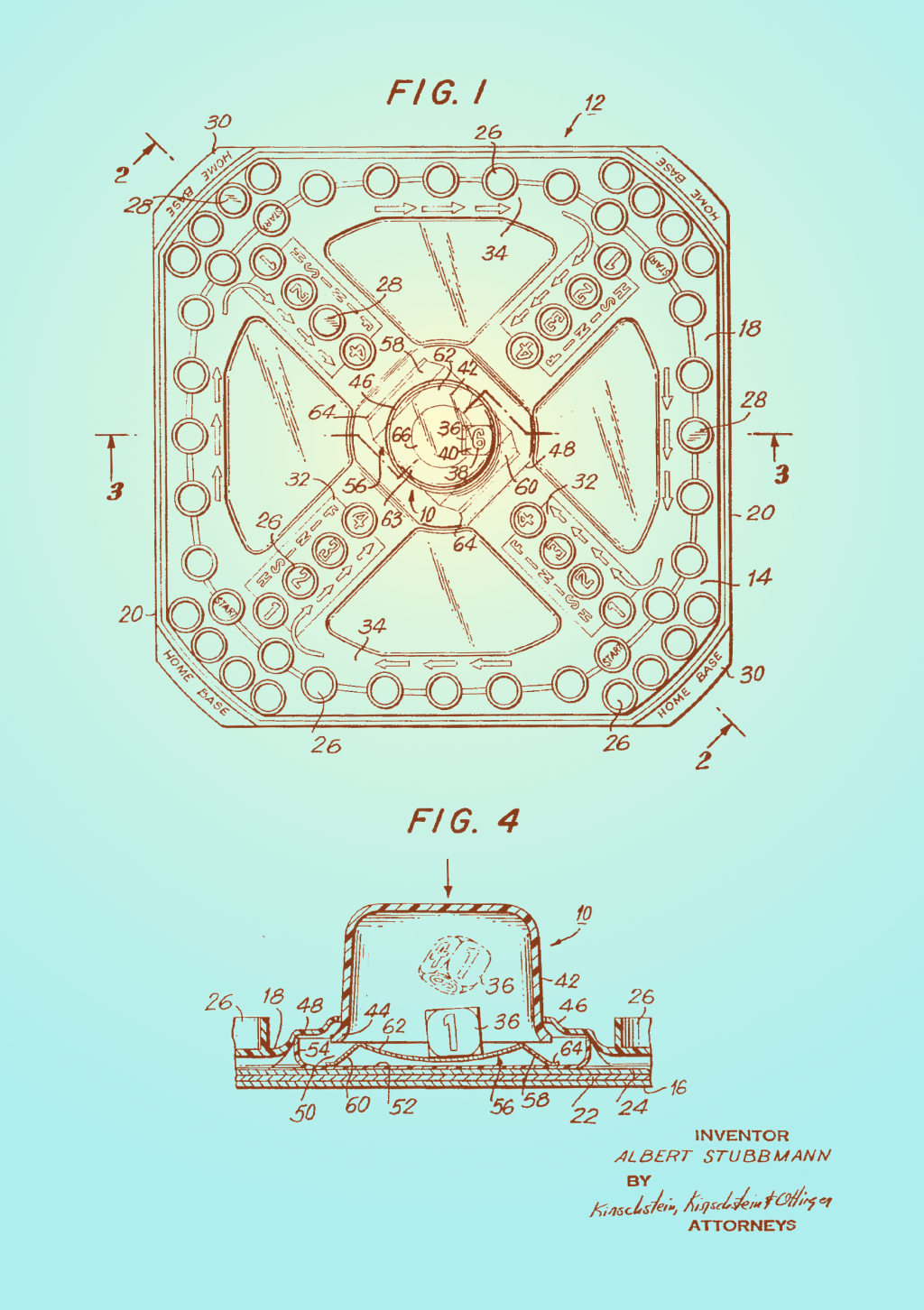
The patent illustration for the “Pop-o-Matic” dice rolling contraption that turned the copyright-free Ludo into the intellectual property that is Frustration.
Illustration Matt Ballantine, 2026
 Random the Book