Questions for you:
- When planning for future risks, do you default to predicting single “most likely” scenarios or do you explicitly model ranges of possible outcomes acknowledging fundamental unpredictability?
- In training and preparation, how much emphasis goes toward optimising predictable execution versus building adaptive capacity to handle unexpected situations?
- Looking at past crises in your organisation, how many resulted from predictable failure modes you planned for versus unpredictable combinations of factors no one anticipated?
- When you can’t reduce randomness or uncertainty, do you shift strategy toward learning to adapt rather than continuing futile attempts at control?
Questions for your organisation:
Wargaming versus traditional scenario planning: Traditional planning assumes single “most likely” scenarios, creating optimised strategies that fail when reality diverges. Wargaming embraces unpredictability by role-playing multiple perspectives with random number generators (dice) modelling unknown factors. This trains decision-making under uncertainty in situations too complex for linear analysis. Unlike scenario planning producing documents, wargaming develops adaptive capacity – participants learn to respond to unexpected developments rather than execute predetermined plans. Apply this to strategic planning, crisis preparation, competitor analysis, and complex negotiations where multiple actors interact unpredictably.
Probabilistic risk assessment accepting uncertainty: Monte Carlo simulation and Probabilistic Risk Assessment (PRA) make uncertainty explicit and quantifiable. During COVID-19, epidemiologists modelled ranges of outcomes rather than single predictions, revealing full spectrum of possibilities under different policies. This identifies robust strategies performing well across varied futures rather than optimal strategies for predicted scenarios. Build PRA frameworks combining expert judgement, historical data, and statistical methods. Accept criticism about false precision for rare events whilst recognising that these offer the best available systematic risk analysis tools. The goal isn’t a perfect prediction, but better preparation through understanding the range and probability of outcomes.
Training for adaptation when randomness can’t be constrained: When uncertainty can’t be reduced, train people to adapt rather than follow protocols. Wargaming teaches decision-making facing simultaneous actions by multiple parties with unknown intentions. Military origins demonstrate value: commanders couldn’t predict battles but could develop adaptive judgement. Apply to customer service (unpredictable situations), incident response (novel failures), negotiations (opponent strategies), and innovation (market responses). Build capacity to recognise patterns, make judgements with incomplete information, and revise decisions as situations evolve rather than executing predetermined responses.
Robust versus optimal strategies: Optimisation for a single predicted scenario creates fragile strategies. Robust strategies perform acceptably across multiple scenarios, even if not optimal for any specific one. Test strategic plans against adverse scenarios, identify dependencies on specific assumptions, build redundancy and flexibility to allow adaptation, and design systems that degrade gracefully under unexpected conditions rather than catastrophically fail. Accept that robust strategies sacrifice peak performance in favourable conditions for acceptable performance across a wider range of possibilities.
Further reading
Wargaming, scenario planning, and preparation for uncertainty
The Art of Wargaming by Peter Perla – comprehensive examination of professional wargaming from Prussian origins to contemporary applications, demonstrating how simulating unpredictable situations trains adaptive decision-making better than scenario planning.
Thinking in Time by Richard E. Neustadt and Ernest R. May – historians’ framework for decision-making under uncertainty showing how analogical reasoning and scenario analysis help prepare for unpredictable situations without false confidence in predictions.
The Black Swan by Nassim Nicholas Taleb – argues rare unpredictable events dominate history, criticising planning methods assuming predictability, advocating for building robustness rather than attempting to predict unpredictable events.
Probabilistic risk assessment and Monte Carlo methods
How to Measure Anything by Douglas W. Hubbard – demonstrates Monte Carlo simulation and probabilistic methods for quantifying uncertainty in business decisions, showing how to make uncertainty explicit rather than pretending single-point predictions are certain.
Against the Gods by Peter L. Bernstein – history of probability and risk management explaining development of tools for reasoning about uncertainty, from gambling mathematics to modern probabilistic risk assessment frameworks.
The Signal and the Noise by Nate Silver – statistician’s examination of prediction demonstrating when probabilistic thinking improves forecasts versus when uncertainty makes prediction impossible, advocating for explicit uncertainty ranges rather than false precision.
Adaptive decision-making and robust strategies
Team of Teams by General Stanley McChrystal – military leader’s account of adapting to unpredictable warfare showing how organisations must build adaptive capacity when facing enemies and situations too complex and fast-moving for traditional planning.
Sources of Power by Gary Klein – research on how experts make decisions under uncertainty and time pressure, showing experienced decision-makers use pattern recognition and mental simulation rather than formal analysis when facing unpredictable situations.
Antifragile by Nassim Nicholas Taleb – argues for designing systems that benefit from volatility and uncertainty rather than attempting to predict and control randomness, advocating robust strategies over optimised but fragile ones.
Interactive exhibit
You can explore Monte Carlo simulations through the medium of a commute to work: https://experiments.randomthebook.com/MonteCarlo/
About the image
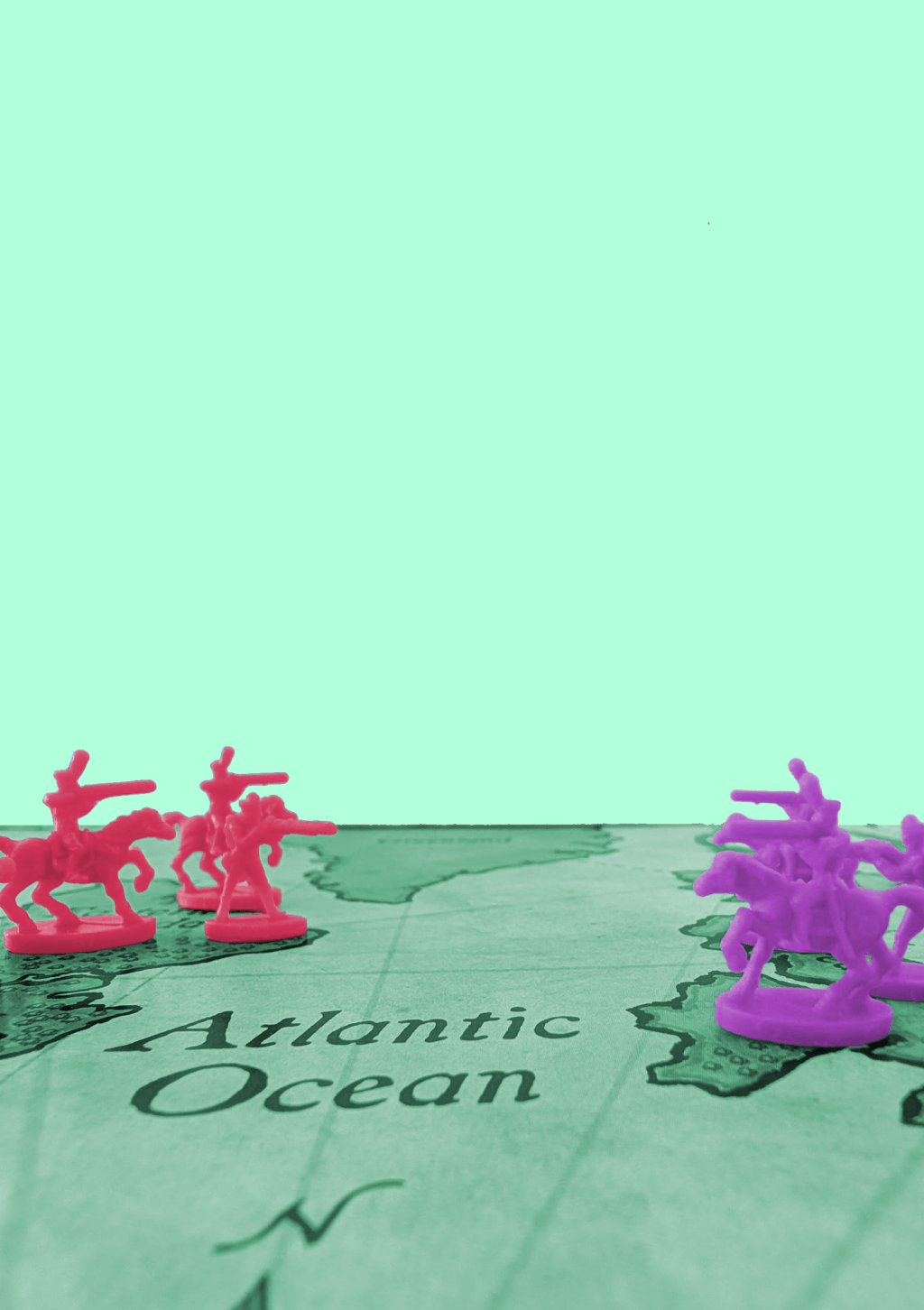
I dug out our edition of the classic board game Risk from the cupboard to stage this shot.
Photo montage and photo by Matt Ballantine, 2026
 Random the Book