Questions for you:
- When you’re stuck on a problem, do you keep staring at it from the same angle, or do you have systematic methods for forcing yourself to approach it differently?
- Think of a recent creative breakthrough – did it come from methodically working through your usual process, or from an unexpected interruption, constraint, or reframing that bypassed your habitual thinking?
- How often do you reject ideas or approaches simply because they feel unfamiliar or uncomfortable, and how might introducing provocations randomly help you explore those rejected paths? Who has the authority of Eno and Schmidt to you? Is that authority necessary?
- How would you advise your closest friend, if they faced your current challenge? And forcing yourself to take your own advice, what would change about your approach – and what does that reveal about your default assumptions?
Organisational applications:
Breaking strategic deadlock: When leadership teams are stuck debating the same options repeatedly, introduce random provocations to break the cycle. Use Oblique Strategies-style prompts: “What would your biggest competitor do?”; “What if you had half the budget?”; “What would success look like to your newest employee?”. Should you prepare these in advance?
Innovation workshop design: Traditional brainstorming often produces predictable ideas because participants unconsciously stay within familiar patterns. Build randomness into the process: draw prompts from a deck, impose arbitrary constraints, combine random elements from different domains. The technique used by musicians from Bowie to Coldplay works equally well for product development, service design, or business model innovation.
Personal productivity unblocking: When individuals are stuck (writing reports, designing solutions, planning projects), provide a set of cryptic prompts they can draw randomly. “Take a break”, “What are you really thinking about just now?”, “Ask your body”, “Honour your error as a hidden intention”. Deliberate ambiguity forces interpretation in the context of a specific situation. This is more effective than prescriptive advice because randomness bypasses defensive rationalisations.
Meeting format disruption: Meetings often follow predictable patterns that limit creative thinking. Introduce random elements: start from a random agenda item, assign random roles (“you’re now the skeptic”, “you’re the optimist”), impose random constraints on solutions. The power lies in unpredictability – participants can’t prepare usual responses or walk through their standard positions, thereby forcing genuine engagement with different perspectives.
Further Reading
Oblique Strategies and creative constraints
A Year with Swollen Appendices by Brian Eno – diary documenting Eno’s creative process including extensive discussion of Oblique Strategies, explaining how random provocations bypass habitual thinking patterns and force genuine reframing of creative problems.
The Creative Habit by Twyla Tharp – choreographer’s guide to creativity including systematic methods for introducing unexpected elements into creative processes, demonstrating that inspiration can be deliberately provoked through structured randomness.
Caffeine for the Creative Mind by Stefan Mumaw and Wendy Lee Oldfield – collection of creative exercises and prompts demonstrating Oblique Strategies principle that random provocations generate novel approaches by preventing habitual thinking patterns.
Breaking creative blocks and cognitive flexibility
Where Good Ideas Come From by Steven Johnson – examines how innovations emerge from unexpected connections, showing that deliberate introduction of randomness and cross-domain exposure increases probability of creative breakthroughs.
The Medici Effect by Frans Johansson – argues that breakthrough innovations occur at intersection of different fields, with practical methods for deliberately creating conditions where unexpected connections emerge.
Lateral Thinking by Edward de Bono – introduces systematic techniques for approaching problems from unexpected angles, including random word technique that parallels Oblique Strategies’ use of unpredictable prompts to escape habitual thought patterns.
Randomness in creative processes
Oulipo: A Primer of Potential Literature edited by Warren Motte – anthology demonstrating how arbitrary constraints and random procedures generate creative solutions, directly parallel to Oblique Strategies principle that randomness enables rather than limits creativity.
Steal Like an Artist by Austin Kleon – emphasises creative theft and recombination, with discussion of how introducing random influences and constraints generates novel approaches by forcing departure from comfortable patterns.
The War of Art by Steven Pressfield – examines creative resistance and methods for overcoming blocks, arguing that systematic disruption of habitual patterns (including random provocations) bypasses internal defensive mechanisms that prevent creative work.
Interactive Exhibit:
I created Cards for Conversations when working with a client who needed help having conversations at senior levels. It’s like Oblique Strategies for CxOs.
https://experiments.randomthebook.com/cardsforconversation/
About the image
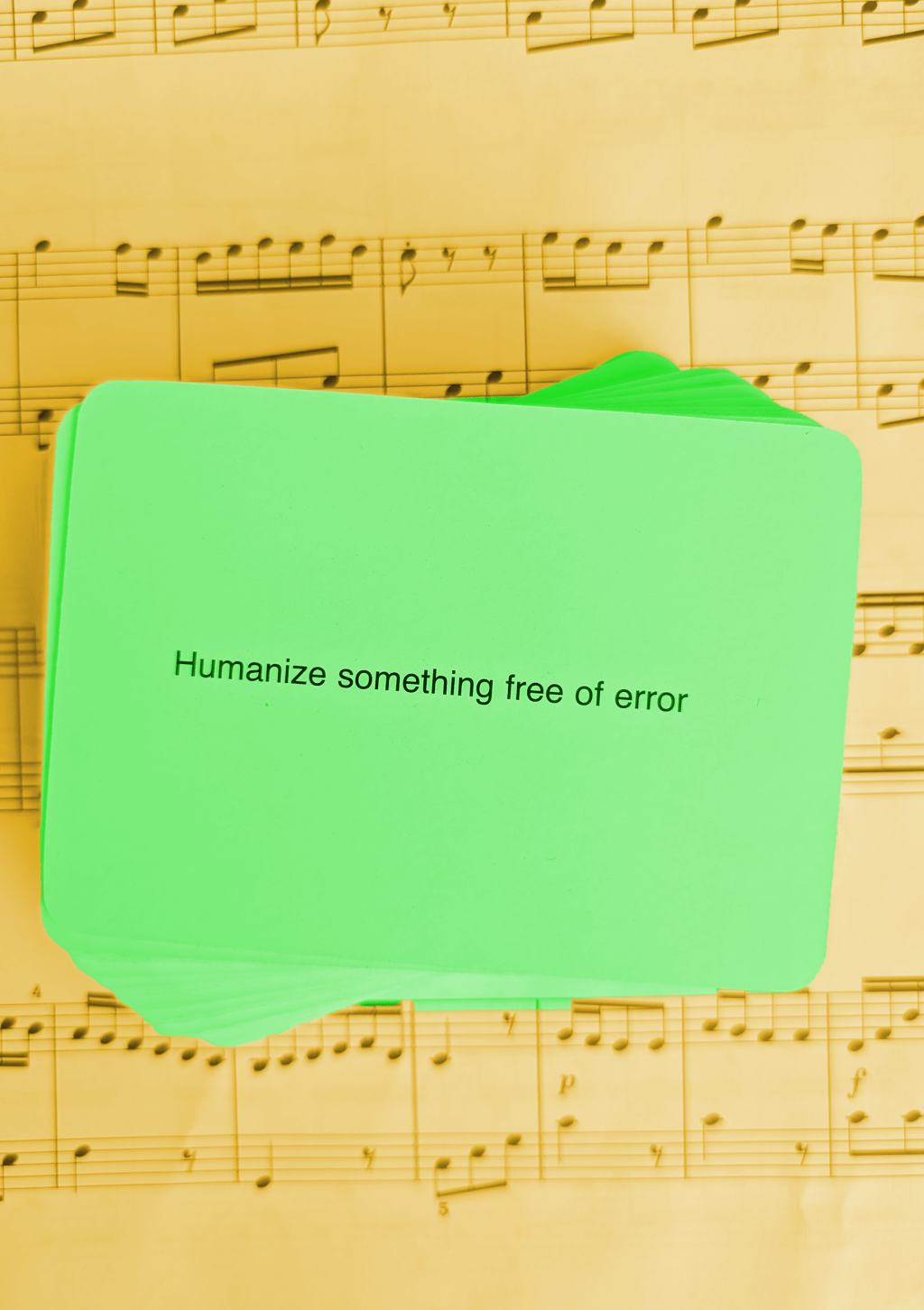
That’s my set of Oblique Strategies, sitting on top of some music I found knocking around the house.
Photo and photo montage Matt Ballantine 2026.
 Random the Book