Questions for you:
- What systems in your work or life give you a sense of progress that might be carefully controlled to maintain motivation without necessarily bringing you closer to actual success?
- If you designed a rewards or recognition system for your team, would you engineer “near wins” to maintain engagement – and would that be ethical or manipulative? And what happens if they find out?
- How often do you continue pursuing something because you’ve already invested time or collected partial progress, even when the final outcome remains statistically unchanged by your “progress”?
- How tired are you of being reminded of the Sunk Cost Fallacy… yet, how often do you find that kind of reminder useful when finally giving up on a project or idea or investment?
Organisational applications:
Gamification ethics audit: If your organisation uses gamification, badges, progress bars, or reward systems, examine whether they provide genuine progress feedback or engineer near-misses to maintain engagement. The McDonald’s approach works because most pieces are distributed randomly whilst one is controlled – creating illusion of progress without actual advancement. Ensure your systems, especially those you’ve purchased or rented, provide honest feedback to your staff about actual achievement.
Recognition system design: Employee reward programmes can inadvertently create McDonald’s-style dynamics where everyone gets common recognitions (Park Lane) but rare rewards (Mayfair) remain concentrated. This maintains engagement through near-misses whilst controlling actual costs. Consider whether this psychological manipulation serves organisational goals or erodes trust when employees recognise the pattern. And looking back, as an individual, which corporate schemes make a lot more sense now?
Consumer psychology awareness: If your organisation designs customer engagement systems, understand the ethics of near-miss engineering. Slot machines and McDonald’s Monopoly both exploit the same cognitive bias. Consider whether driving engagement through manufactured “almost winning” feelings aligns with your organisational values and long-term customer relationships.
Further reading:
Psychology of near-misses and gambling
Addiction by Design by Natasha Dow Schüll – ethnographic study of slot machine design in Las Vegas, demonstrating how engineers deliberately programme near-miss frequencies to maximise addictive engagement, directly paralleling McDonald’s approach of controlling rare pieces whilst distributing common ones.
The Design of Everyday Things by Don Norman – classic text on design psychology including discussion of feedback systems and how apparent progress influences user behaviour, with implications for understanding engineered near-misses in various contexts.
Thinking, Fast and Slow by Daniel Kahneman – Nobel laureate’s analysis of cognitive biases including near-miss effects and how System 1 (fast, intuitive thinking) interprets close calls as evidence of near-success even when outcomes are statistically independent.
Probability misunderstanding and exploitation
- The Theory of Gambling and Statistical Logic by Richard A. Epstein – mathematical analysis of gambling games showing how controlling distribution of rare elements creates illusion of achievability, explaining why McDonald’s Monopoly feels winnable despite mathematical improbability.
- Duped: Truth-Default Theory and the Social Science of Lying and Deception by Timothy R. Levine – examines how people fail to detect deception because they assume randomness and honesty by default, relevant to understanding why engineered near-misses feel genuine rather than manipulative.
- Predictably Irrational by Dan Ariely – demonstrates systematic irrationality in human decision-making including how partial ownership or progress creates commitment even when rational analysis suggests abandoning pursuit.
Ethics of engagement design
- Hooked: How to Build Habit-Forming Products by Nir Eyal – examines ethical implications of designing addictive products using variable rewards and progress mechanics, directly applicable to understanding McDonald’s Monopoly and similar engineered engagement systems.
- The Age of Surveillance Capitalism by Shoshana Zuboff – analyses how companies engineer experiences to maximise engagement and data extraction, with discussion of psychological manipulation techniques including near-miss engineering in digital contexts.
- Evil by Design by Chris Nodder – explores dark patterns in user experience design including manufactured scarcity and engineered near-wins, providing framework for evaluating whether engagement techniques cross into manipulation.
About the image
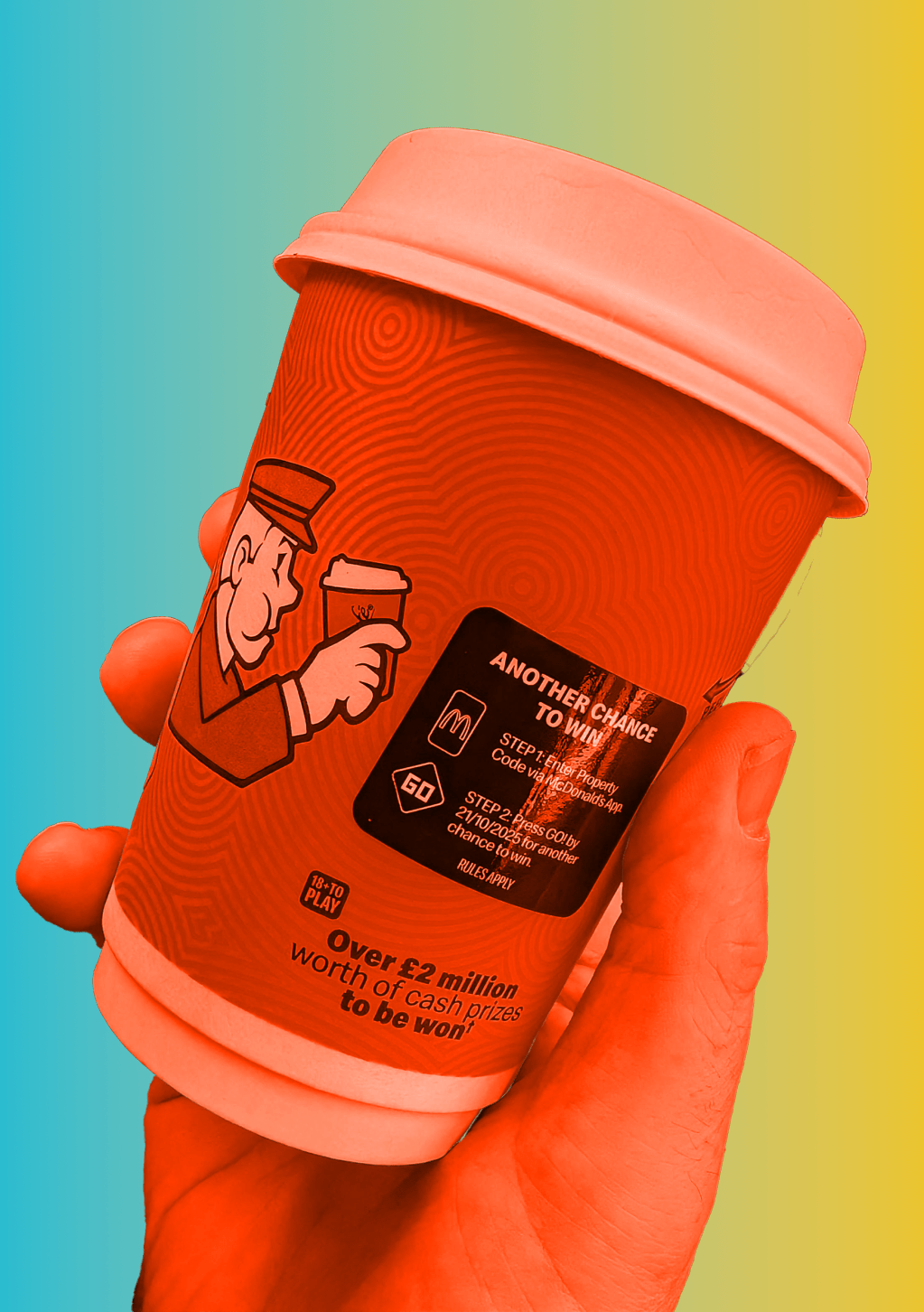
I’m very partial to a Sausage McMuffin for breakfast. This was a coffee cup I had during the Monopoly promotion in 2025. The tasty treats are enough reward for me…
Photo and photomontage, Matt Ballantine 2026
 Random the Book