Questions for you:
- When did I last create something through a process where I couldn’t see the full picture?
- What would happen if I deliberately limited my view of a problem to force unexpected combinations?
- Rather than clamouring for more information, where can I experiment with less information to see what creations emerge?
Organisational applications:
Blind contribution ideation workshops:
Like surrealists folding paper to hide prior contributions, organisations can structure ideation in which participants contribute without seeing others’ input. Implement “sequential blind brainstorming,” in which team members add ideas to documents or proposals without reading previous contributions, while maintaining grammatical or structural constraints (e.g., budget format, technical requirements, customer needs) to prevent groupthink. When revealed, these combinations often produce unexpected synergies that are impossible through conventional collaborative ideation that is heavily influenced by previous ideas. Track whether blind contribution generates qualitatively different ideas compared with traditional brainstorming, either by changing your method for different projects, or running at least two teams in parallel.
Constrained random recombination processes:
The exquisite corpse maintains grammatical structure (adjective-noun-verb) whilst randomising content—it’s constrained randomness, not pure chaos. Apply this principle to organisational challenges: when developing strategies, randomly recombine components from different successful initiatives (customer segment from Project A, delivery model from Project B, pricing from Project C) whilst maintaining business model coherence. Like how “the exquisite corpse will drink the new wine” follows grammar rules whilst combining unexpected elements, force combinations respecting structural constraints whilst ensuring incompatible content. Give the process sufficient time, and sporadically encourage participants to create the least viable combination to ensure sessions stay playful and open-minded.
Fragmented collaboration for breakthrough concepts:
Traditional collaboration assumes coordination improves outcomes. Exquisite corpse demonstrates value in deliberate non-coordination—participants create better collective results precisely because they cannot coordinate. Implement “fragmented sprints” in which teams work on different aspects of problems without cross-team communication, then require integration. Engineering develops technical architecture without knowing user experience decisions; marketing creates positioning without seeing the product roadmap; operations plans delivery without knowing pricing. When integrated, the incompatibility forces creative solutions. Compare outcomes from fragmented versus coordinated collaboration only once the process is complete, measuring whether enforced non-coordination produces more innovative solutions despite requiring more integration work.
Emergent meaning recognition capabilities:
Exquisite corpse works because humans recognise meaningful patterns in random combinations—”the exquisite corpse will drink the new wine” feels poetic despite accidental construction. Develop organisational capabilities for recognising value in unplanned combinations that formal processes would reject. When random project pairings, unintended technology combinations, or accidental market applications emerge, train teams to evaluate potential rather than dismissing incompatibility. The statistical reality is that enough random combinations will produce genuinely valuable results, but organisations trained to dismiss unplanned outcomes systematically miss them.
Further reading
On exquisite corpse and surrealism:
Exquisite Corpse: Chance and Collaboration in Surrealist Photography (Tate Modern exhibition catalogue). Documentation of surrealist techniques including exquisite corpse methodology and examples of collaborative works.
The Exquisite Corpse (Museum of Modern Art collection notes). Video and historical context for the surrealist game, explaining how meaning emerges from blind collaboration.
Surrealism: The Road to the Absolute by Anna Balakian (University of Chicago Press, 3rd edition, 1986). Academic examination of surrealist movement including techniques using randomness and unconscious collaboration to generate art bypassing conscious control.
On collaborative creativity and constraint:
Group Genius: The Creative Power of Collaboration by Keith Sawyer (Basic Books, 2007). Research on collaborative creativity including when limiting information flow between collaborators enhances rather than diminishes collective output.
Where Good Ideas Come From: The Natural History of Innovation by Steven Johnson (Riverhead Books, 2010). Explores how innovation emerges from unexpected combinations including when restricted information creates productive collisions between incompatible ideas.
On pattern recognition and emergent meaning:
The Act of Creation by Arthur Koestler (Macmillan, 1964). Classic examination of creativity including how mind recognises patterns and meaning in unexpected juxtapositions, foundational for understanding why random combinations produce aesthetic responses.
I Am a Strange Loop by Douglas Hofstadter (Basic Books, 2007). Exploration of how minds create meaning from patterns including why grammatically correct random text can feel meaningful despite lacking intentional content.
Metaphors We Live By by George Lakoff and Mark Johnson (University of Chicago Press, 1980). Demonstrates how minds automatically construct meaning from combinations of unlike concepts, explaining why exquisite corpse generates poetic rather than nonsense results.
About the image
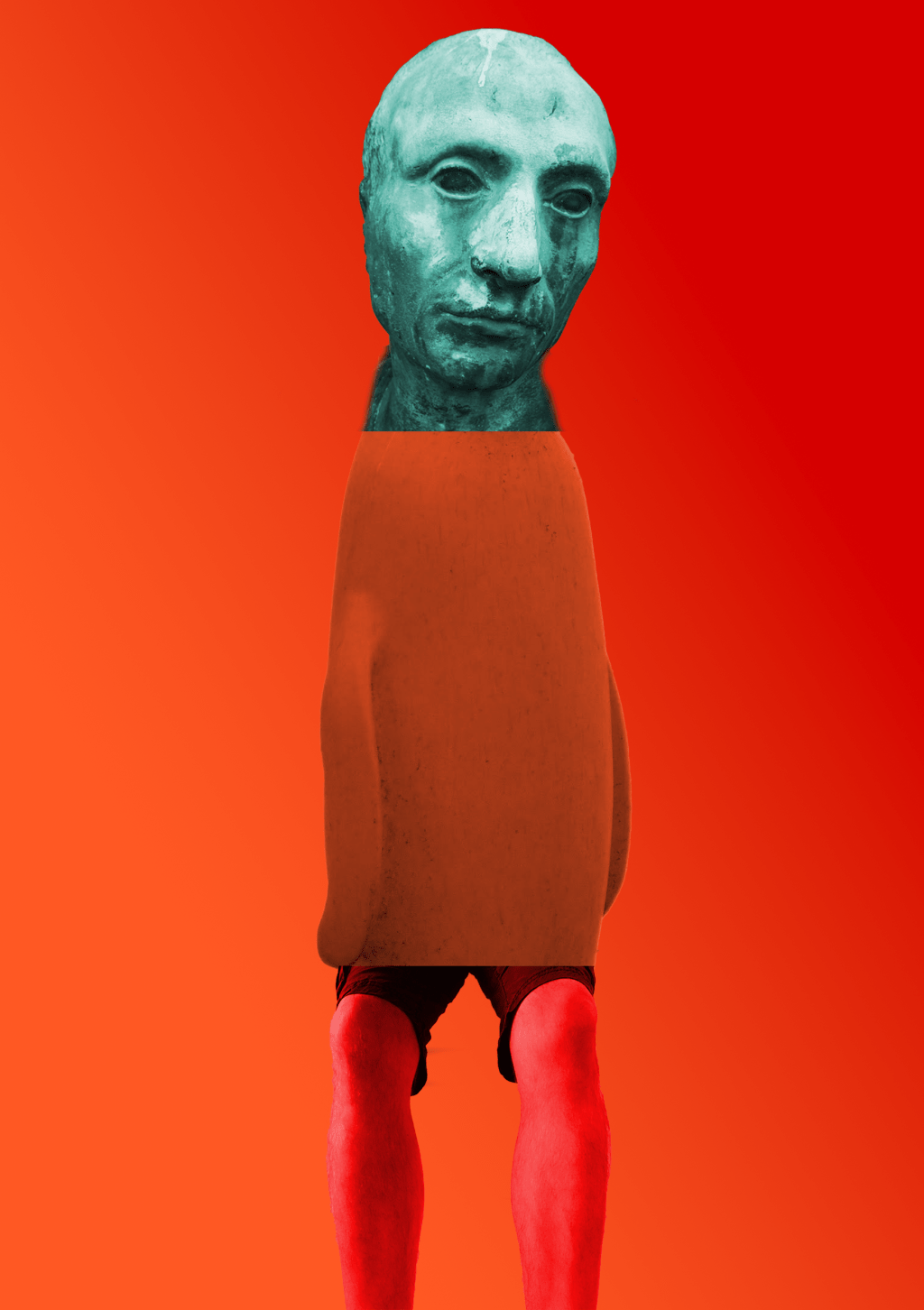
My attempt at an exquisite corpse image, using three photographs: the face is from a particularly freaky set of busts outside of Ham House, the National Trust stately home on the other side of the River Thames from where we live; the body is one of the penguins from the glorious Cracking Art Group sculpture in Kampa Park in Prague; the legs are mine.
Photomontage Matt Ballantine 2026.
 Random the Book