Questions for you:
- When I have an intuitive sense that something’s wrong, do I trust it enough to investigate systematically?
- When I have an intuitive sense that something’s wrong, is that instinct reliable enough that I can save time by acting on it immediately, rather than trying to investigate it systematically?
- How do I translate gut reactions into language and evidence that others will take seriously?
- Do I dismiss either intuition or systematic analysis too readily when they conflict, and if so – which way do I usually fall?
Organisational applications:
Organisational Applications: “Why do we scramble to justify our snap judgements?”
Intuition capture mechanisms:
Pattern-recognition expertise develops through extensive experience, but organisational systems often require explicit justification before acting on intuitive signals. Like sensing something’s wrong before articulating why, experienced professionals often detect anomalies through unconscious pattern-matching that precedes conscious analysis. Employees should be encouraged to keep “intuition logs”, recording unexplained concerns before gathering supporting data. On an appropriately secure system, these could be used to review whether anyone had previously recorded any unexplained concerns.
Bridge protocols between intuition and systematic analysis:
Kahneman’s Type 1 (fast, intuitive) and Type 2 (slow, systematic) thinking represent different cognitive modes, but organisations often privilege one whilst dismissing the other. Create explicit workflows bridging intuitive detection with systematic investigation: when someone reports an unexplained concern, trigger a rapid preliminary investigation rather than demanding immediate justification. Like jazz musicians who’ve mastered fundamentals before improvising, experienced professionals’ intuitions deserve investigation even when not yet analytically justified. Over time measure whether these “intuition-triggered investigation” protocols surface problems faster than pure systematic monitoring or pure intuitive response.
Post-rationalisation awareness training:
Mercier and Sperber argue that Type 2 thinking represents the post-rationalisation of gut feelings rather than an independent analytical process—we generate justifications for conclusions already reached intuitively. If their hypothesis is accurate, this means much systematic analysis is only for social legitimation rather than for unearthing conclusions. Train teams to recognise post-rationalisation by comparing initial feelings to eventual outcomes, and track whether awareness of post-rationalisation improves decision quality by making teams question whether “analysis” actually changed anything, and therefore how their analytical processes need to be changed to be of value.
Expertise recognition in uncertainty contexts:
In genuinely uncertain environments where not everything is measurable, experienced intuition often outperforms systematic analysis because experts unconsciously weight factors that formal models miss. But organisations trained to privilege quantitative justification systematically undervalue expertise-based intuition. Create “expert override” protocols that allow recognised domain experts to record or even escalate concerns, even when complete systematic justification is lacking, with retrospective analysis determining whether expert intuition proved valuable. Like chess grandmasters who “see” good moves before calculating variations, organisational expertise often manifests as pattern-recognition preceding articulation.
Further reading
On intuition versus systematic thinking:
Thinking, Fast and Slow by Daniel Kahneman (Farrar, Straus and Giroux, 2011). Nobel laureate’s comprehensive examination of System 1 (fast, intuitive) versus System 2 (slow, systematic) thinking including why intuition often proves valuable despite apparent irrationality.
The Enigma of Reason by Hugo Mercier and Dan Sperber (Harvard University Press, 2017). Alternative theory arguing systematic reasoning serves social justification of intuitive conclusions rather than independent analysis, challenging Kahneman’s dual-process model.
Blink: The Power of Thinking Without Thinking by Malcolm Gladwell (Little, Brown, 2005). Popular examination of rapid intuitive judgements including when snap decisions prove superior to deliberative analysis and when intuition misleads.
On expertise and pattern recognition:
Sources of Power: How People Make Decisions by Gary Klein (MIT Press, 1998). Research on naturalistic decision-making showing how experts use intuitive pattern recognition in time-pressured uncertain environments, challenging rational choice models.
Educating Intuition by Robin M. Hogarth (University of Chicago Press, 2001). Examination of how intuition develops through experience and when intuitive judgements prove reliable versus misleading, with frameworks for calibrating trust in gut feelings.
Expert Political Judgment: How Good Is It? How Can We Know? by Philip E. Tetlock (Princeton University Press, 2005). Long-term study finding expert intuition often proves no better than chance for complex predictions, questioning when to trust expertise-based intuition.
On organisational decision-making:
Nudge: Improving Decisions About Health, Wealth, and Happiness by Richard H. Thaler and Cass R. Sunstein (Yale University Press, 2008). Behavioral economics approach recognizing both systematic and intuitive thinking modes, with strategies for structuring decisions accounting for both.
The Fifth Discipline: The Art & Practice of The Learning Organization by Peter Senge (Doubleday, 1990). Systems thinking approach including tension between analytical models and intuitive understanding in organizational contexts.
Gut Feelings: The Intelligence of the Unconscious by Gerd Gigerenzer (Viking, 2007). Defense of intuitive decision-making showing when simple heuristics outperform complex analysis, particularly under uncertainty with limited information.
About the image:
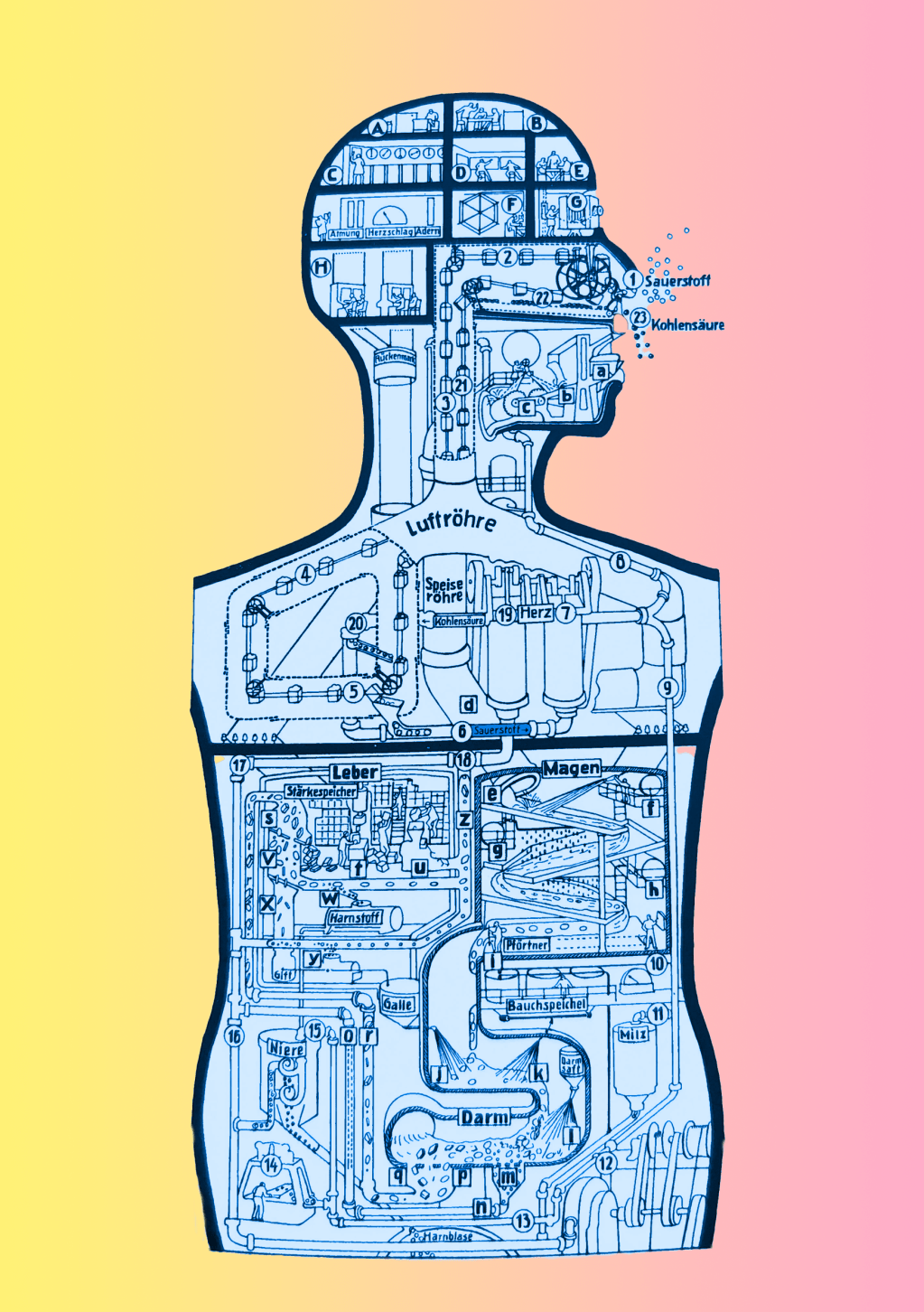
The original image is from the German infographics pioneer, Fritz Kahn, taken from the book Fritz Kahn, Infographics Pioneer. It’s a wonderful example of how the prevailing technologies of the era determine how we think about how the human body and brain works. A similar diagram created today would almost certainly be based around computers and robots rather than mechanical machines.
Illustration, Fritz Kahn, Man as Industrial Palace, 1928. Photomontage Matt Ballantine 2026.
 Random the Book