Questions for you:
- What patterns do I observe repeatedly but I have never tried to understand the underlying systems, or mathematics?
- Where am I relying on intuition when I could develop a more rigorous understanding?
- What would it mean to bring analytical thinking to areas of my life I currently treat as purely intuitive?
- Am I resistant to dragging myself out of implicit knowledge to explicit knowledge? And if so, why?
Organisational applications:
- Systematic failure documentation and analysis:
Establish formal processes to capture insights from failed projects, lost deals, and operational mistakes. Like Cardano learning probability from gambling losses, organisations accumulate valuable knowledge through failures but rarely systematise it. Create repositories where employees document what went wrong and why, stripped of blame but rich in analytical detail. Schedule regular reviews looking for patterns across failures. Most organisations have sophisticated success-tracking systems but virtually no equivalent for failures, when you carefully avoid “blamestorming” this process can give you a rare business advantage. - Internal knowledge publication requirements:
Implement mandatory documentation and internal publication of significant research, experiments, or analytical work completed by teams. Valuable insights are routinely siloed within departments, known only to those directly involved, like Cardano’s century-unpublished manuscript. Require teams completing major analyses to produce accessible summaries for internal knowledge bases, with time allocated for this documentation. Track what percentage of analytical work gets captured versus lost when employees leave or projects conclude. The gap between knowledge created and knowledge shared often represents wasted investment. - Practitioner-to-theory translation programmes:
Create formal mechanisms translating practical operational experience into systematic frameworks and training materials. Frontline employees develop a sophisticated understanding of how systems actually work, or fail, versus how they’re supposed to, but this tacit knowledge rarely gets codified. Like Cardano, systematising gambling observations into mathematical principles, establish processes in which experienced practitioners work with analysts to document their decision-making frameworks, troubleshooting approaches, and pattern recognition. This prevents losing organisational knowledge through turnover, and will accelerate new employee development. - Post-mortem to publication pipelines:
After significant incidents, competitive losses, or strategic pivots, don’t just conduct private post-mortems—produce edited versions for broader organisational learning. Most companies conduct incident reviews that yield valuable insights but keep them confidential to small groups. Establish protocols for sanitising and publishing anonymised case studies internally, complete with analysis frameworks and decision trees. Universities publish case studies about others’ experiences; organisations should publish case studies about their own. The discipline of preparing insights for publication forces clearer thinking than purely internal analysis.
Further reading
On the history of probability:
The Emergence of Probability: A Philosophical Study of Early Ideas about Probability, Induction and Statistical Inference 2nd Edition by Ian Hacking (Cambridge University Press, 2013). Comprehensive examination of how probability theory emerged from gambling mathematics in the 16th and 17th centuries, including Cardano’s contributions.
Against the Gods: The Remarkable Story of Risk by Peter L. Bernstein (Wiley, 1996). Accessible history of probability and risk management from ancient times through modern finance, with substantial coverage of early probability pioneers including Cardano, Pascal, and Fermat.
Cardano’s Cosmos: The Worlds and Works of a Renaissance Astrologer by Anthony Grafton (Harvard University Press, 1999). Biographical examination of Cardano’s life and work, contextualising his probability insights within his broader Renaissance scholarship.
On organisational knowledge and learning:
The Knowledge-Creating Company: How Japanese Companies Create the Dynamics of Innovation by Ikujiro Nonaka and Hirotaka Takeuchi (Oxford University Press, 1995). Framework for how organisations convert tacit knowledge into explicit knowledge and disseminate it systematically, addressing why valuable insights often remain locked in individual experience.
Working Knowledge: How Organizations Manage What They Know by Thomas H. Davenport and Laurence Prusak (Harvard Business School Press, 1998). Practical guide to knowledge management including why organisations fail to capture and share internally-generated insights.
The Fifth Discipline: The Art and Practice of the Learning Organization by Peter M. Senge (Doubleday, 1990). Classic on organisational learning emphasising how companies systematically capture and apply knowledge from experience rather than letting insights dissipate.
On learning from failure:
Black Box Thinking: Why Most People Never Learn from Their Mistakes—But Some Do by Matthew Syed (Portfolio, 2015). Examines why some industries systematically learn from failures (aviation) whilst others don’t (healthcare, business), with practical frameworks for failure analysis and knowledge capture.
Right Kind of Wrong: The Science of Failing Well by Amy C. Edmondson (Atria Books, 2023). Research-based framework for intelligent failure—how organisations can create cultures where failures generate systematic insights rather than blame, similar to Cardano deriving probability theory from gambling losses.
About the image
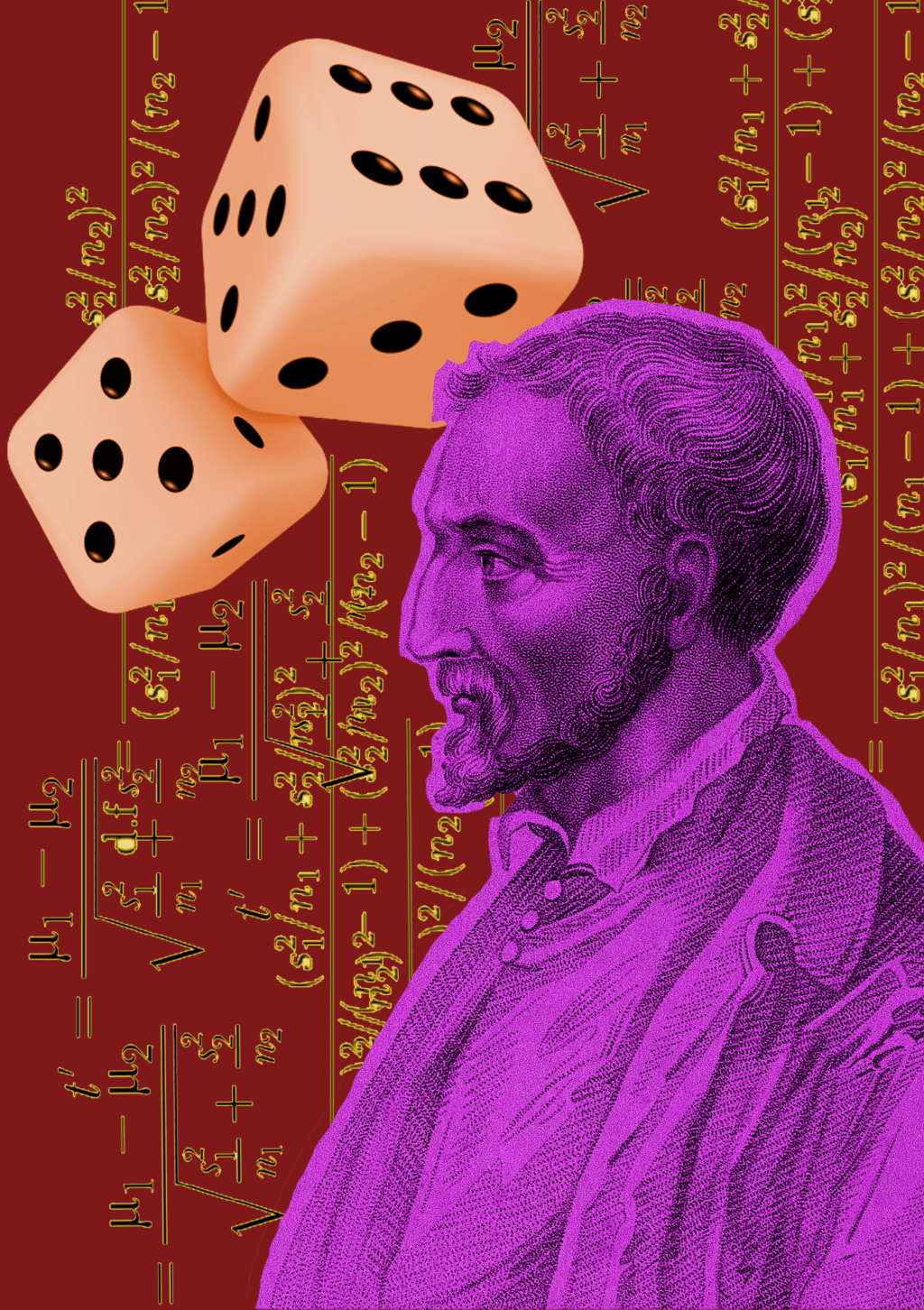
There are three elements – some computer-generated dice mid-throw, some nonsense mathematical notation in the background and an image of Cardano taken from the Wellcome Collection.
Photomontage Matt Ballantine 2026
Public domain stipple engraving of Geralamo Cardano from https://wellcomecollection.org/works/q737gkmx
 Random the Book