Questions for you:
- Where do I feel an irrational need for control, even over genuinely random events?
- What social conventions do I follow at work that aren’t necessary, and are hampering my productivity or enjoyment of my tasks?
- In what areas of my work do I resist delegating or trusting processes because of this deep-seated need for control, how can I safely explore that?
Organisational applications:
- Delegation with outcome acceptance:
Train managers to distinguish between decisions they can genuinely influence and outcomes they merely want to feel they control. When delegating tasks with uncertain outcomes (sales pitches, recruitment decisions, vendor negotiations), managers often micromanage not because their involvement improves results but because surrendering control creates visceral discomfort. Implement training in which managers accept that factors outside of their control, and some factors outside of anyone’s control, will determine results regardless of who executes the task. - Randomised process assignment:
For tasks where outcome depends substantially on chance rather than skill (whether a customer has the time or budget to respond, which regulator reviews an application, which overall market conditions prevail), randomly assign responsibility rather than letting senior staff claim high-profile opportunities and/or easy wins. This breaks the illusion that specific individuals control fundamentally random outcomes whilst ensuring equitable access for all your staff. If you’ve had the historical data to call on before, track whether these randomly-assigned responsibilities produce different results from strategically-assigned ones, or run both systems in parallel. - Algorithmic decision-making adoption:
Organisations struggle to adopt superior algorithmic decision systems because humans resist surrendering control even when algorithms demonstrably outperform human judgment. Hiring managers insist on final say despite algorithms predicting performance better. Loan officers override credit models despite worse default rates. The resistance isn’t about actual performance—it’s visceral discomfort with not rolling the dice personally. Apply proposed algorithms transparently to historical decisions, would they have produced better results? - Lottery-based opportunity allocation:
For opportunities with uncertain outcomes where multiple qualified candidates exist (conference attendance, training programmes, high-visibility projects), use transparent lotteries rather than discretionary selection. This acknowledges that among qualified candidates, success often depends on random factors anyway whilst eliminating politics around who “deserves” chances. Resistance to lottery systems reveals how strongly people believe their judgment adds value even when random allocation would produce equivalent or better fairness and outcomes.
Further reading
On NLP:
Jon Ronson wrote a fantastic piece about one of NLP’s founders, Richard Bandler, here: https://www.theguardian.com/lifeandstyle/2006/may/20/weekend.jonronson1
On illusion of control:
“The Illusion of Control” by Ellen J. Langer (Journal of Personality and Social Psychology, 1975). Seminal research demonstrating humans systematically overestimate their control over random events, believing skill influences purely chance outcomes.
The Psychology of Judgment and Decision Making by Scott Plous (McGraw-Hill, 1993). Accessible overview of decision-making biases including illusion of control, with practical examples and experimental demonstrations.
Predictably Irrational: The Hidden Forces That Shape Our Decisions by Dan Ariely (HarperCollins, 2008). Accessible examination of systematic irrationalities in decision-making including illusion of control and resistance to delegating random-outcome decisions.
On delegation and algorithmic decisions:
Turn the Ship Around!: A True Story of Turning Followers into Leaders by L. David Marquet (Portfolio, 2012). Submarine commander on relinquishing control whilst maintaining accountability, demonstrating how delegation with outcome independence improves results.
Algorithms to Live By: The Computer Science of Human Decisions by Brian Christian and Tom Griffiths (Henry Holt, 2016). Explores optimal decision algorithms and why humans resist adopting superior algorithmic methods even when evidence clearly demonstrates better performance.
Prediction Machines: The Simple Economics of Artificial Intelligence by Ajay Agrawal, Joshua Gans and Avi Goldfarb (Harvard Business Review Press, 2018). Economic analysis of why organisations resist AI-driven decisions, including the psychological costs of control loss.
On process versus outcome:
Thinking in Bets: Making Smarter Decisions When You Don’t Have All the Facts by Annie Duke (Portfolio, 2018). Professional poker player on evaluating decision quality separately from outcomes, especially important when random factors dominate results.
“Outcome Bias in Decision Evaluation” by Jonathan Baron and John C. Hershey (Journal of Personality and Social Psychology, 1988). Research showing people judge decisions by outcomes rather than process quality, even when outcomes depend primarily on chance.
The Tyranny of Merit: What’s Become of the Common Good? by Michael J. Sandel (Farrar, Straus and Giroux, 2020). Philosophical examination of meritocracy including arguments for lottery-based selection where merit differences are marginal and outcomes substantially random.
About the image
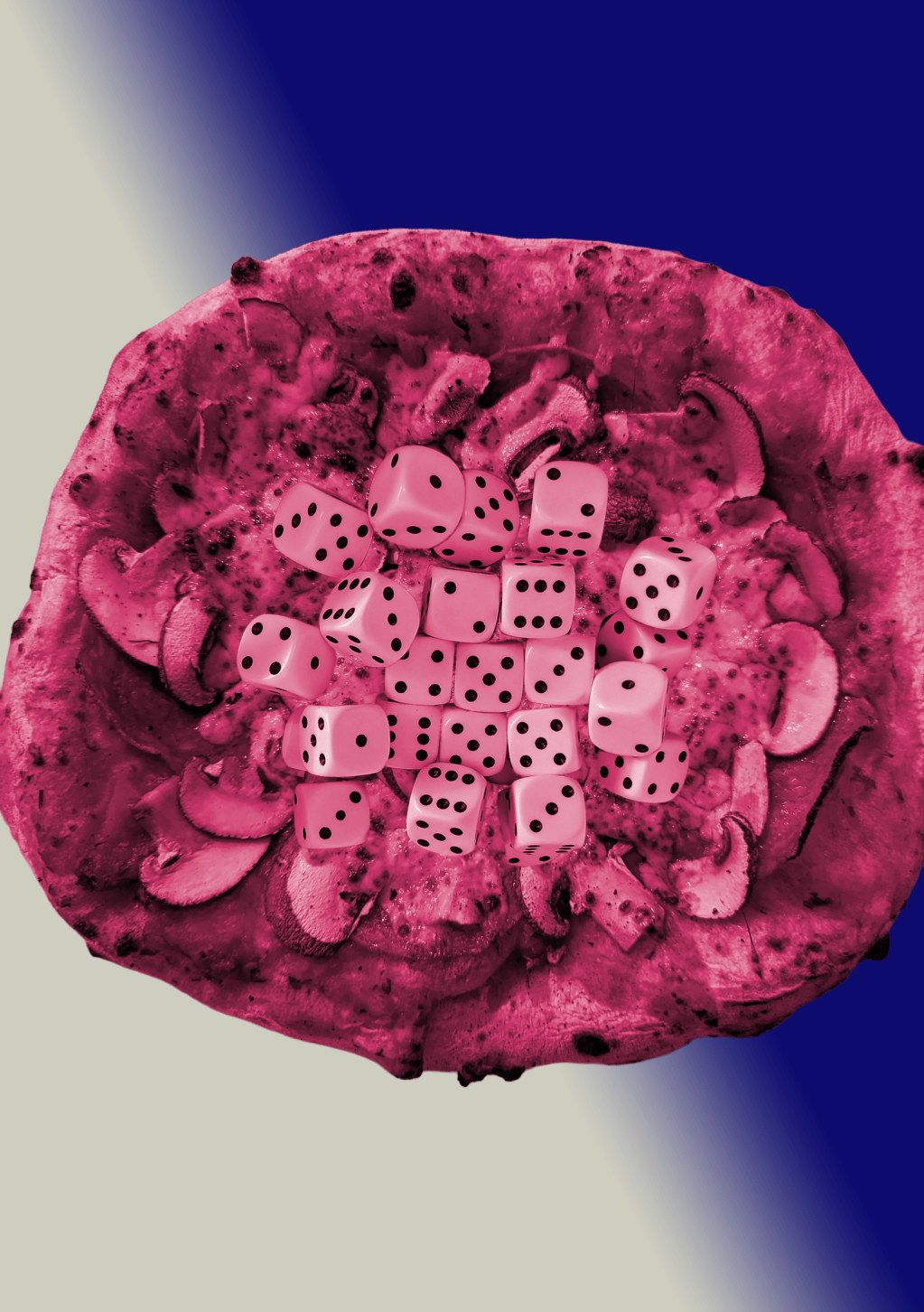
The original version of this image, generated by an LLM, upset a few of our test readers. So I recreated it using a photo of one of the pizzas I baked, along with some dice that Nick’s partner Dee photographed for this montage. Just for fun, we left the original AI image on the book cover so you can judge for yourself which is better.
Photo of pizza and photo montage Matt Ballantine 2019, 2026; Photo of dice Dee Mamora 2025
 Random the Book