Questions for you
- When I review numbers in reports or data, do I have any instinct for what “natural” distributions should look like?
- Have I ever noticed that data seemed suspiciously neat or evenly distributed?
- Do I understand the basic principle well enough to explain why fabricated numbers often fail this test?
Organisational applications:
Systematic expense report screening:
Implement automated Benford’s Law analysis on all expense submissions before processing payments. The system flags submissions where first-digit distributions deviate significantly from expected patterns (1 appearing ~30%, 9 appearing <5%). This highlights potential fabrication attempts invisible to manual review—when employees create fictional receipts, they unconsciously distribute digits evenly. Review flagged submissions more closely whilst processing conforming submissions normally.
Vendor invoice validation:
Apply Benford’s Law testing to invoices from suppliers, particularly those submitting high volumes of small transactions where manual verification is impractical. Fraudulent suppliers often generate plausible-looking invoice amounts that fail statistical tests. Compare digit distributions across different vendors to identify outliers requiring investigation. Particularly effective for detecting fictitious vendors or inflated pricing schemes operating at scale.
Financial reporting integrity checks:
Build Benford’s Law analysis into quarterly and annual financial reporting processes as routine verification before submission to boards or external auditors. Management teams pressured to meet targets sometimes manipulate figures that seem reasonable individually but create suspicious statistical patterns in aggregate. Testing revenue figures, cost allocations, and budget variance reports can reveal systematic manipulation invisible in a line-by-line review.
Data quality assessment for analytics:
Use Benford’s Law as early-warning system for data quality problems in operational datasets feeding business intelligence systems. When transaction logs, customer counts, or usage metrics show suspicious digit distributions, it indicates either fraud or systematic data collection problems. This matters because analytics built on corrupted data produce misleading insights. Establish baseline digit distributions for different data types and flag deviations requiring investigation before data enters analytical workflows.
Additional reading:
On Benford’s Law fundamentals:
Wikipedia’s entry on Benford’s Law: https://en.wikipedia.org/wiki/Benford%27s_law
Benford’s Law: Applications for Forensic Accounting, Auditing, and Fraud Detection by Mark J. Nigrini (Wiley, 2012). Comprehensive practitioner’s guide to applying Benford’s Law in forensic accounting, with case studies, technical details on when the law applies, and practical implementation guidance for fraud detection.
“The Law of Anomalous Numbers” by Frank Benford (Proceedings of the American Philosophical Society, 1938). Benford’s systematic empirical study establishing the pattern across diverse datasets, giving the law its modern name.
On forensic applications:
Forbes article on Greece financial crisis: https://www.forbes.com/sites/sap/2015/07/09/greece-financial-crisis-data-science-could-have-exposed-warning-signs/
Reuters article on corporate applications: https://www.reuters.com/article/world/using-benfords-law-to-avoid-corporate-chicanery-james-saft-idUS1982543742/
Forensic Analytics: Methods and Techniques for Forensic Accounting Investigations by Mark J. Nigrini (Wiley, 2011). Broader forensic accounting text with several chapters on digital analysis including Benford’s Law applications alongside other statistical fraud detection methods.
Financial Shenanigans: How to Detect Accounting Gimmicks & Fraud in Financial Reports by Howard Schilit and Jeremy Perler (McGraw-Hill Education, 4th edition, 2018). Financial statement fraud detection including discussion of statistical red flags like Benford’s Law violations.
On research data integrity:
Science Fictions: How Fraud, Bias, Negligence, and Hype Undermine the Search for Truth by Stuart Ritchie (Metropolitan Books, 2020). Examines how fabricated research data is detected through statistical anomalies including Benford’s Law violations, with case studies of major scientific fraud.
“The GRIM Test: A Simple Technique Detects Numerous Anomalies in the Reporting of Results in Psychology” by James Heathers et al. (Social Psychological and Personality Science, 2016). Related statistical method for detecting impossible summaries in published research, complementing Benford’s Law analysis.
About the image
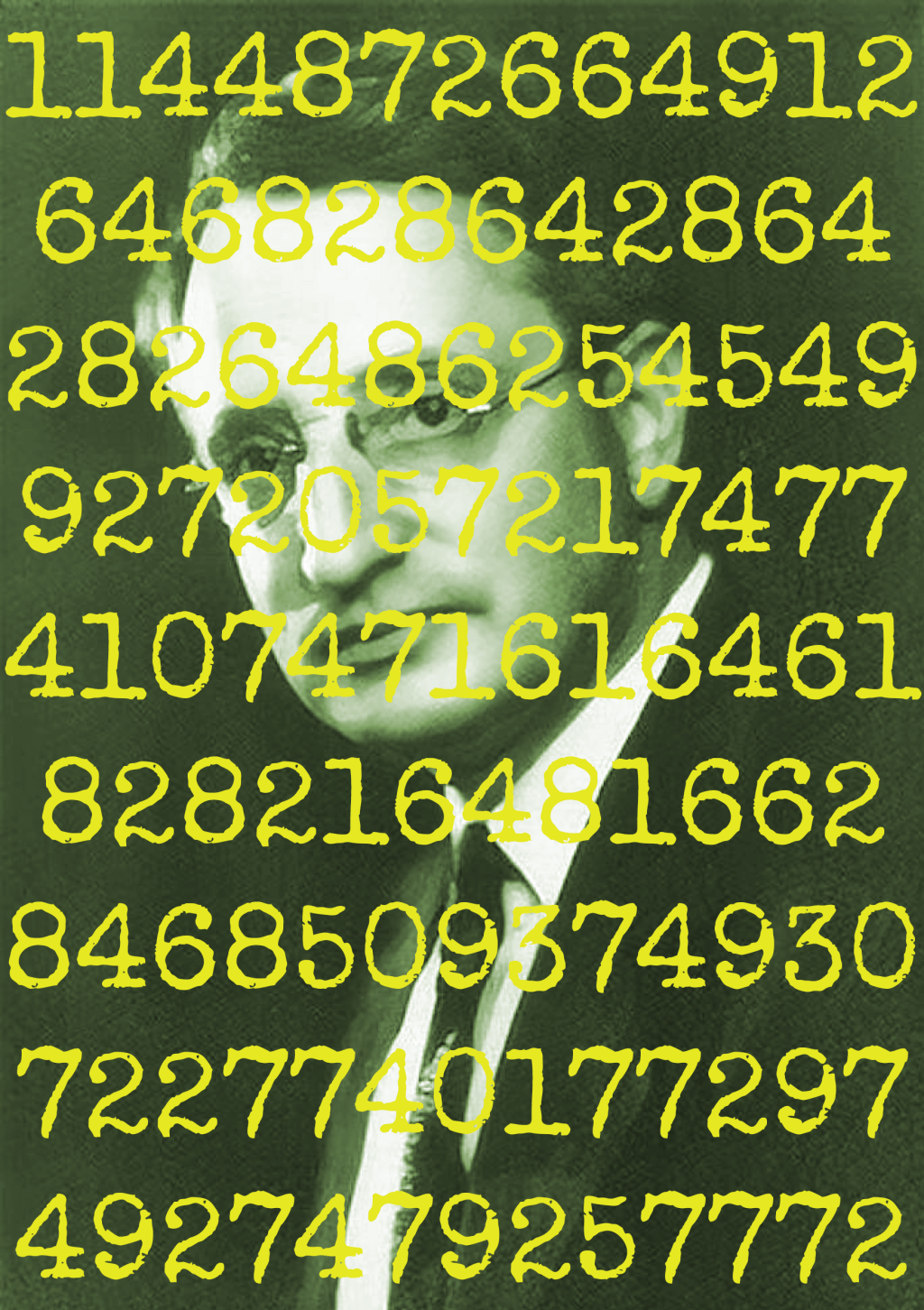
In the background is an image of Frank Benford, overlaid with a sequence of random numbers. Or are they?
Photo https://commons.wikimedia.org/wiki/File:Frank_Benford_(1883_-_1948).jpg CC SA 4.0
Photo montage Matt Ballantine 2026
 Random the Book
.jpg)