Questions for you:
- When I describe my own work, do I retrofit intention onto processes that were actually more exploratory or accidental?
- How much of my creative or problem-solving process involves responding to unexpected developments rather than executing a plan?
- Do I give myself credit for the skilful response to accidents, or only for successful execution of intentions?
Organisational applications:
- Constrained improvisation workshops:
Implement “structured chaos” sessions where teams tackle problems under random constraints. Set strict time limits (15 minutes to solve a problem), random role assignments (an engineer must present a marketing perspective), or arbitrary material restrictions (design only using three colours). The constraints channel creative energy whilst the randomness forces departure from habitual approaches. As with jazz improvisation, this requires deep expertise operating within unexpected restrictions, producing solutions that wouldn’t emerge from conventional brainstorming. - Rapid prototyping with staged abandonment of ideas:
Establish two-phase development cycles: chaotic exploration followed by disciplined refinement in a loop. In exploration phases, teams generate numerous rough prototypes without quality filters, allowing apparently random combinations and half-formed ideas. Track which “accidents” prove valuable when subjected to refinement in the later phase compared to the team’s initial expectations. This overtly separates generative chaos from evaluative discipline, acknowledging that breakthrough innovations often look absurd initially but can become brilliant through skilled development and redevelopment. - Strategic scenario improvisation:
Train leadership teams to improvise responses to randomly-generated crisis scenarios without them having time to prepare. Present them with unexpected combinations of challenges (supply chain disruption plus regulatory change plus a key resignation) and require immediate strategic responses. Like Pollock’s controlled drips, the specific challenges are unpredictable but the decision-making framework has been frequently explored. This builds an organisational capability to respond to uncertainty rather than demanding perfect predictions when faced with very wide ranges of potential outcomes. - Cross-pollination through controlled collision of roles:
Deliberately create project teams from incompatible disciplines or departments, forcing them to reconcile contradictory approaches. Pair engineers with marketers, combine conservative divisions with experimental units, or mix seniority levels randomly. The resulting blend requires synthesis rather than compromise, often producing hybrid approaches neither group would conceive independently, or encouraging techniques from a specific silo to shared with other parts of the company. Structure the collaboration framework in advance, and facilitate the sessions strongly, whilst letting the conceptual chaos generate novelty.
Further reading
On improvisation in organisations:
Yes to the Mess: Surprising Leadership Lessons from Jazz by Frank J. Barrett (Harvard Business Review Press, 2012). Explores how jazz improvisation principles apply to organisational leadership, balancing structure with spontaneity and preparation with flexibility.
In the Moment: Build Your Confidence, Communication and Creativity at Work by Neil Mullarkey (KoganPage, 2023). Comedy Store Players co-founder applies improv theatre techniques to business communication, leadership and creativity. Shortlisted for Business Book Awards 2024, with practical frameworks for working with uncertainty in professional contexts.
Jamming: The Art and Discipline of Business Creativity by John Kao (HarperBusiness, 1996). Examines how musical improvisation models can inform organisational creativity and innovation processes.
On creativity under constraints:
A Whack on the Side of the Head: How You Can Be More Creative by Roger von Oech (Warner Books, 1983). Classic creativity text advocating random disruption of habitual thinking patterns through constraints and provocations.
The Innovator’s DNA: Mastering the Five Skills of Disruptive Innovators by Jeff Dyer, Hal Gregersen and Clayton M. Christensen (Harvard Business Review Press, 2011). Research-based examination of how constraints and cross-pollination drive innovation.
On Pollock and abstract expressionism:
A biography of Pollock and a timeline of his work: https://www.theartstory.org/artist/pollock-jackson/
The interactive exhibit below was inspired and informed by this article about the complexity of the techniques that Pollock used: https://swarezart.com/drip-painting-technique/
Jackson Pollock: An American Saga by Steven Naifeh and Gregory White Smith (Clarkson Potter, 1989). Definitive biography exploring Pollock’s artistic process and the tension between control and chaos in his work.
Abstract Expressionism by David Anfam (Thames & Hudson, 1990). Art historical examination of how abstract expressionists used controlled chaos as technique, with detailed analysis of working methods.
On chance operations in art:
Silence: Lectures and Writings by John Cage (Wesleyan University Press, 1961). Cage’s own writings on using chance operations (I Ching, random number tables) as compositional tools whilst maintaining artistic intent.
Writings Through John Cage’s Music, Poetry, and Art by David W. Bernstein and Christopher Hatch (University of Chicago Press, 2010). Academic examination of Cage’s systematic approaches to incorporating randomness into creative work.
On design thinking and rapid prototyping:
The Lean Startup: How Today’s Entrepreneurs Use Continuous Innovation to Create Radically Successful Businesses by Eric Ries (Crown Business, 2011). Advocates rapid experimentation and iterative development, accepting chaotic exploration within structured validation frameworks.
Sprint: How to Solve Big Problems and Test New Ideas in Just Five Days by Jake Knapp (Simon & Schuster, 2016). Google Ventures’ method for constrained innovation sprints that channel creative chaos through strict time limits and frameworks.
Creative Confidence: Unleashing the Creative Potential Within Us All by Tom Kelley and David Kelley (Crown Business, 2013). IDEO founders on design thinking methods that embrace messiness and iteration as paths to innovation.
On balancing order and chaos:
How Buildings Learn: What Happens After They’re Built by Stewart Brand (Viking, 1994). Examines how successful buildings balance planned structure with organic adaptation over time, relevant metaphor for organisational design.
The Innovator’s Dilemma: When New Technologies Cause Great Firms to Fail by Clayton M. Christensen (Harvard Business Review Press, 1997). Classic text on why structured processes sometimes prevent innovative responses, and when chaos serves organisations better than order.
On deliberate practice and spontaneity:
Peak: Secrets from the New Science of Expertise by Anders Ericsson and Robert Pool (Houghton Mifflin Harcourt, 2016). Research on how deep preparation enables sophisticated improvisation, explaining why Pollock’s “chaos” required years of disciplined skill development.
The Talent Code: Greatness Isn’t Born. It’s Grown. Here’s How by Daniel Coyle (Bantam, 2009). Explores how intensive practice creates the foundation for apparently spontaneous creative performance.
Interactive exhibit
Try your own hand at drip painting with this Jackson Pollock Simulator: https://experiments.randomthebook.com/pollock/index.html
About the image
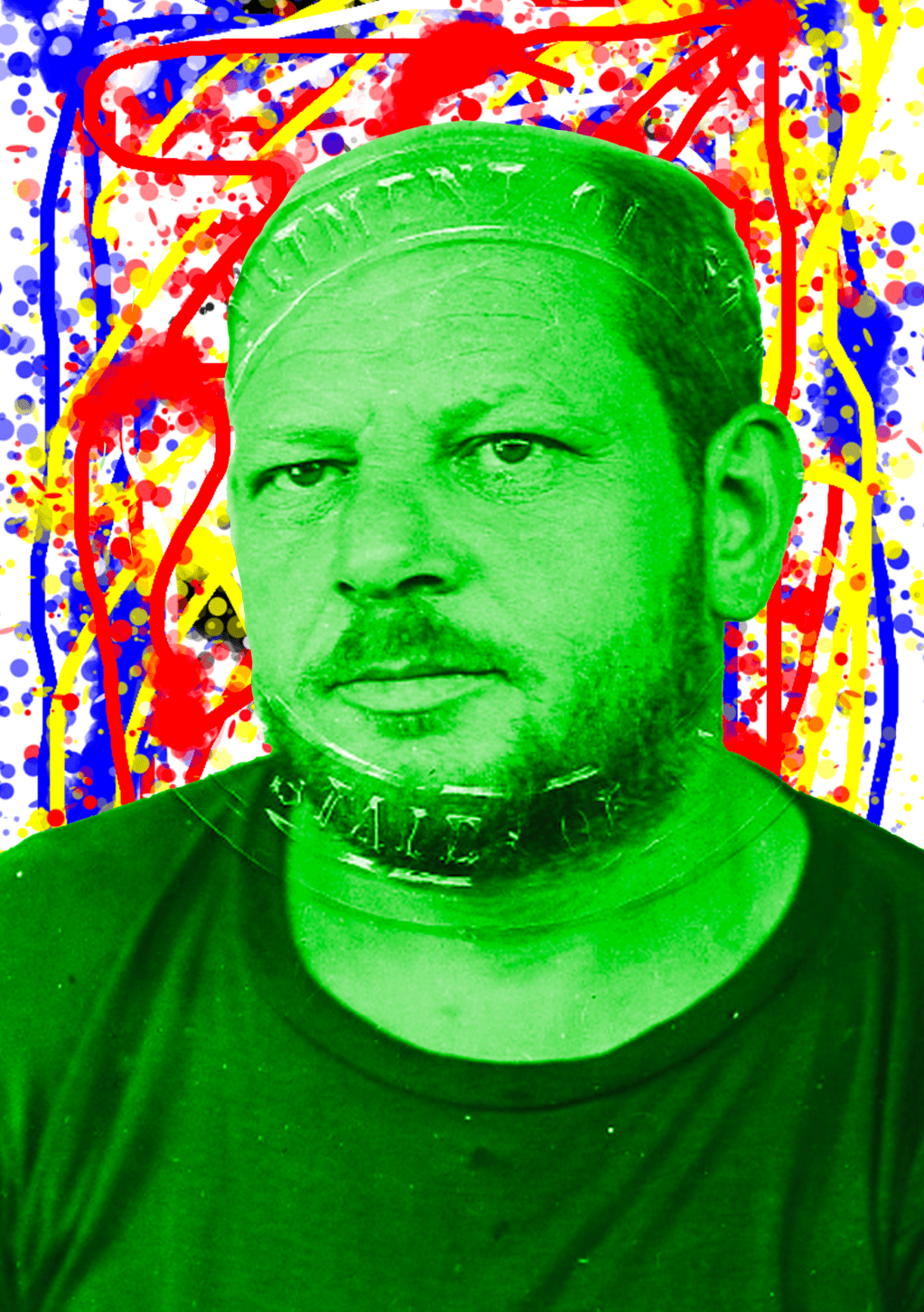
The foreground image is of Jackson Pollock, taken from his passport, which is in the Smithsonian Collection.
The background image was generated using the Jackson Pollock Simulator.
Photomontage Matt Ballantine 2026.
 Random the Book