Questions for you:
- When do I dismiss creative work as “mere chance” when the aesthetic result genuinely moves me?
- Am I too attached to the idea that beauty must be intentionally created to be valid?
- What random combinations or accidents have I encountered that produced unexpectedly compelling results?
Applications for your organisation:
- Idea generation through combinatorial methods:
Systematically generate large numbers of concept variations by randomly combining existing elements (brand attributes, visual motifs, messaging angles), then apply human judgment to select the most compelling results. This produces options your team wouldn’t consciously create, while maintaining quality control through curation. Use random word generators, image combinators, or parameter shufflers to bypass team members’ habitual preferences and preconceptions. - Error documentation and adoption:
Systematically document production accidents, glitches, and unintended effects that produce interesting aesthetic results. Maintain an “accident archive” and periodically review it for elements worth intentionally adopting. Many successful design elements began as manufacturing errors or technical limitations that proved aesthetically compelling. - Serendipitous collaboration formats:
Implement structured random collaboration techniques borrowed from Surrealist methods: team members contribute to projects without seeing others’ contributions, creating unexpected juxtapositions that can be refined. Use tools such as collaborative documents, in which participants add content to different sections independently, or rotate incomplete work randomly among team members at set intervals. - Prototype discovery through generative systems:
Deploy algorithmic systems to generate thousands of design variations (logos, layouts, product configurations) and have human experts select the most promising candidates for refinement. This separates the generation phase (where randomness excels) from the curation phase (where human aesthetic judgment adds value). Document which random variations get selected to reveal underlying aesthetic preferences.
Further reading
On aesthetics and randomness in art:
Chance and Control: Art in the Age of Computers by James Faure Walker (Occasional Papers, 2006). Explores how artists use random processes whilst maintaining aesthetic control, examining the tension between accident and intention in computer-generated art.
Random Order: Robert Rauschenberg and the Neo-Avant-Garde by Branden W. Joseph (MIT Press, 2003). An academic study of how post-war artists incorporated chance operations into their work, particularly examining Rauschenberg’s collaborations with John Cage.
The Poetics of Indeterminacy: Rimbaud to Cage by Marjorie Perloff (Northwestern University Press, 1981). Literary and artistic analysis of how avant-garde creators used randomness and indeterminacy as aesthetic strategies.
On Surrealism and collaborative creation:
A Book of Surrealist Games edited by Alastair Brotchie and Mel Gooding (Shambhala Redstone, 1995). Collection of Surrealist games including detailed instructions for exquisite corpse and other collaborative random techniques used by Breton, Éluard, and their circle.
The Automatic Message by André Breton (1933). Surrealist manifesto exploring automatic writing and other techniques for accessing unconscious creativity through reduced conscious control.
On beauty and intentionality:
On Beauty and Being Just by Elaine Scarry (Princeton University Press, 1999). Philosophical examination of what makes things beautiful and whether intentionality is necessary for aesthetic experience.
The Sense of Beauty by George Santayana (Dover Publications, 1896/1955). Classic aesthetic philosophy arguing that beauty exists in the observer’s experience rather than the creator’s intention.
On creative accidents and serendipity:
How Creativity Happens in the Brain by Arne Dietrich (Palgrave Macmillan, 2015). Neuroscientific examination of creative processes, including the role of unexpected combinations and happy accidents in innovative thinking.
Where Good Ideas Come From: The Natural History of Innovation by Steven Johnson (Riverhead Books, 2010). Explores “the adjacent possible” and how innovations emerge from unexpected combinations rather than deliberate planning.
Imagine: How Creativity Works by Jonah Lehrer (Houghton Mifflin Harcourt, 2012). Though later discredited for fabrications in other sections, the chapters on creative accidents and unexpected combinations remain well-researched.
On generative and algorithmic art:
When the Machine Made Art: The Troubled History of Computer Art by Grant D. Taylor (Bloomsbury Academic, 2014). Historical examination of computer-generated art from the 1960s onwards, addressing questions of authorship and aesthetic value.
10 PRINT CHR$(205.5+RND(1)); : GOTO 10 by Nick Montfort et al. (MIT Press, 2012). Deep analysis of a single line of randomly-generated art code, exploring how simple algorithms can produce complex aesthetic experiences.
Code as Creative Medium: A Handbook for Computational Art and Design by Golan Levin and Tega Brain (MIT Press, 2021). Practical and theoretical examination of how artists use algorithms and randomness as creative tools.
On aesthetic judgment:
The Art Instinct: Beauty, Pleasure, and Human Evolution by Denis Dutton (Bloomsbury Press, 2009). Explores whether aesthetic preferences are evolutionary adaptations and why humans find certain random patterns (sunsets, natural landscapes) beautiful despite their lack of intentional design.
Ways of Seeing by John Berger (Penguin, 1972). Classic text on how context and framing affect aesthetic judgment – relevant to understanding why we value differently-originated beauty differently.
Interactive exhibit
You can also have a play with Drip painting in a homage to Jackson Pollock here:
https://experiments.randomthebook.com/pollock
About the image
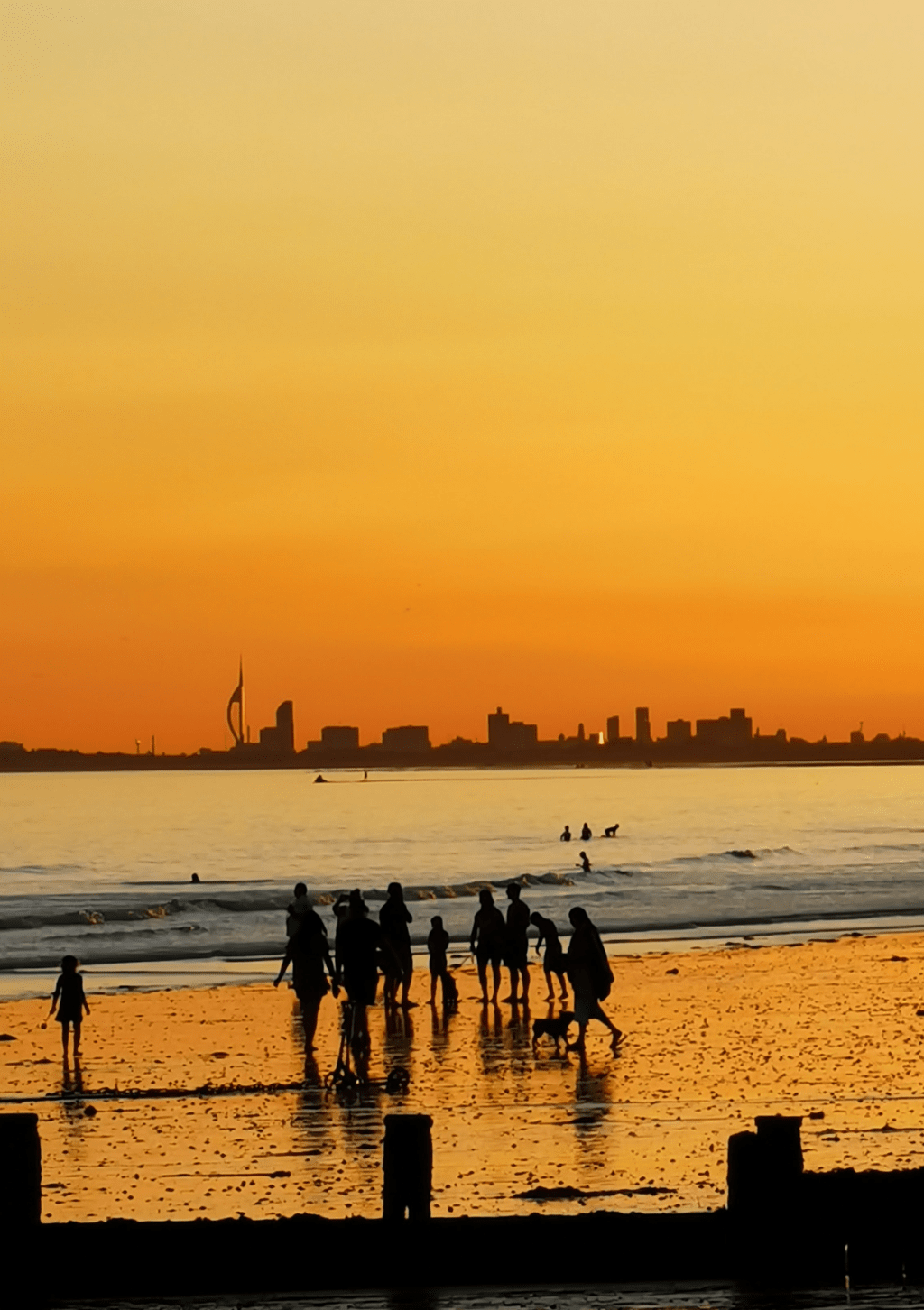
This is the only image in the book which is not artificially colourised. It was taken at the beach in East Witttering in Sussex, UK, in the summer of 2020, looking out to the town of Portsmouth in Hampshire.
Photo Matt Ballantine 2020.
 Random the Book