
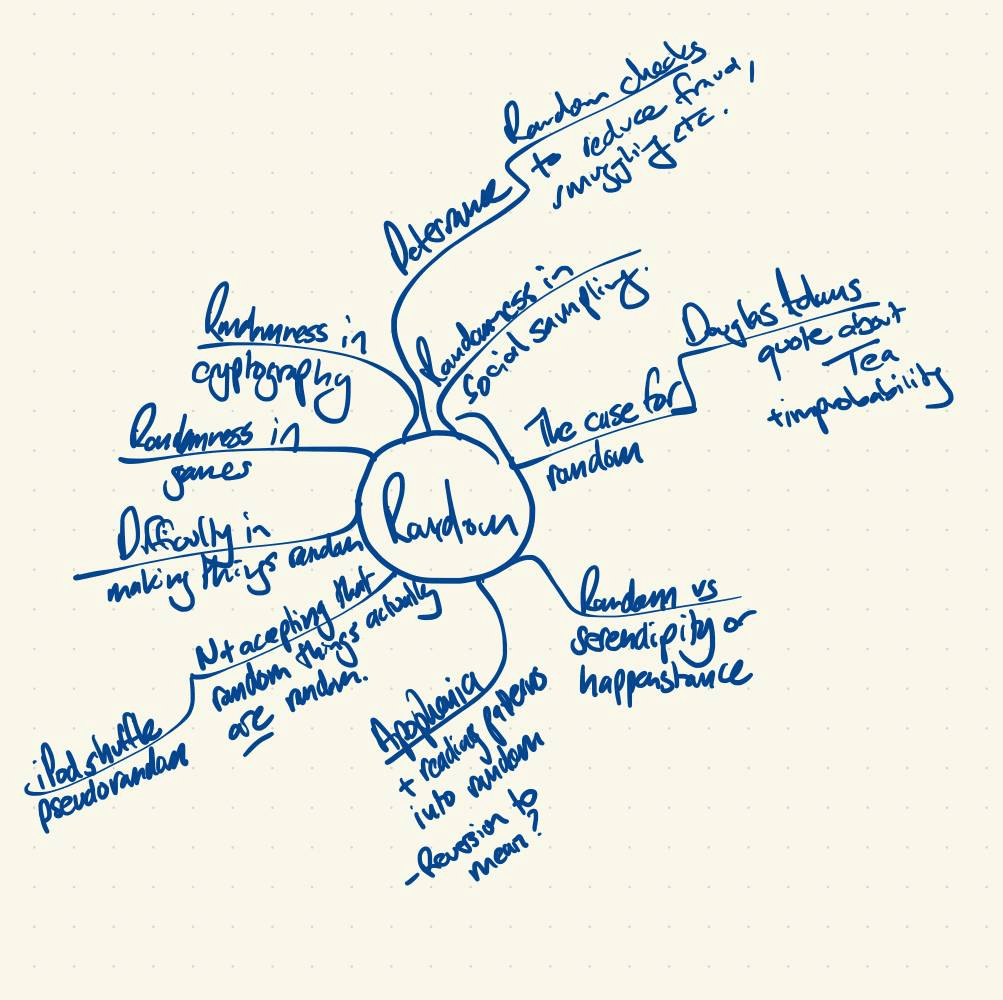
Two months after starting this project, we have a structure for the book.
We currently expect to have 10 chapters. The opening chapter will set the scene. The last chapter will draw some general conclusions.
The eight chapters in the middle will each be self contained. Readers will be able to read them in the order in which they are printed, or, alternatively, they will be able to obtain a randomly selected order of reading. We’ll be building the machine that will do that random selection and write about it in one of the chapters.
Here then are the eight theme chapters in no particular order. Feedback and suggestions most welcomed in comments here, on LinkedIn or via email or messaging.
Serendipity, fate and chance
It was fate led to Matt’s narrow defeat by a mere 12 votes in the spring of 1993 at the Loughborough Students’ Union Presidential election.
In 2024 it was the skillfully-run electioneering of the UK Labour Party that enabled them to win a huge majority of seats on a relatively small share of the popular vote.
Both of these outcomes were determined by relatively random factors, yet illustrate how randomness is perceived differently depending on the outcomes.
In this chapter, we will explain how and why randomness is interpreted. We will also explore superstitions and how we want to exert control over the uncontrollable. We will see how those beliefs can actually improve our mindset and performance.
Ultimately, we will help you rethink your relationship with randomness and how, while we can’t control it, we can improve our responses to it.
Hacking Apophenia
The human brain has an amazing ability to spot patterns in random information. From seeing animals in the clouds above us, via the mysteries of tarot, to modern Internet-charged conspiracy theories, this ability called apophenia can be a blessing and a curse.
In this chapter, we will explore when apophenia is beneficial, such as in certain types of creative thinking, and when it becomes a liability, potentially clouding judgment in critical situations. You will learn to differentiate between useful insights and misleading patterns, whether in self-reflection or analyzing others.
You’ll also see how apophenia is a key driver of many cognitive biases.
This chapter blends science, psychology, and real-world experiences through intriguing examples like the Turing hypothesis, sports performance analysis, and even the eerie curse of the film The Exorcist. We’ll also find out about the random creativity of Matt’s coffee machine
Whether you’re a curious thinker or a professional seeking to harness the power of pattern recognition, this exploration of apophenia will give you a better understanding of how you perceive the world around you.
The Shuffle Phenomenon
Many things we think are random have been cleverly and extensively engineered to give that perception but are not truly random.
From Spotify’s seemingly innocent shuffle function to controversial video game “loot boxes,” intentionally simulated randomness is all around us.
This chapter explores the psychology of randomness and how companies exploit this to manipulate your behaviour. Whether it’s the thrill of McDonald’s “Monopoly” stickers or the unrealistically frequent near-misses of scratchcards, you’ll see how the illusion of chance is crafted to keep you coming back for more.
Building Randomness
Generating random numbers is hard. In this chapter Matt and Nick will prove the point by attempting to build a machine that will generate random sequences by which readers can read this book, enabled by solar-powered miniature arm-waving cats. Yes, you read that right.
Along the way, we’ll explore the history of random number generation, from early dice to roulette wheels and fruit machines. We’ll find out about the first electronic random number generator in the UK, the Premium Bonds’ ERNIE system (and how that linked to cracking the Enigma code), how the UK banking system has relied on noise, and also why a technology services company built a wall of Lava Lamps to keep us safe on the Internet.
This chapter will help you better understand when you might need truly random things and when “randomish” is good enough.
Random Games
When Olympian Adam Peaty lost out on his third successive Olympic gold medal by two-hundredths of a second and was diagnosed with Covid the next day, was it skill or randomness that caused that outcome?
Some games are decided by random chance, and others have randomness built in as a key mechanic through dice or card shuffling. Sports like football or swimming seem mostly devoid of randomness, and games like chess pride themselves on being seemingly only based on skill.
This chapter explores the profound impact of seemingly trivial random elements, illustrating how they can alter the fate of individuals and entire teams. What does a football or cricket captain make of the importance of a coin toss? How does drawing tiles in Scrabble make or break a player’s strategy? And what can you learn from these experiences?
Random Safety
Randomness has a huge and pivotal role in safeguarding our lives.
Understand how randomness is the backbone of airport security checks, ensuring that even the most seasoned traveller cannot predict when they might be stopped. Learn about the ingenious methods behind Internet document filenames and how randomness keeps them from prying eyes.
We’ll also explore examples of how randomness provides this, from the clever random recombinations of our bodies’ T-Cells, to how a lack of randomness led to the discovery of the infamous LIBOR scandal.
This chapter will give you a new appreciation of where randomness makes you safer on a daily basis.
Sampling
Random sampling is a core technique in medicine and social science. It allows researchers to test ideas and compounds on a subset of the population. It’s also used for certain democratic roles, such as Jury Service or the recent Irish Citizen’s Assembly.
But what if we were to randomly allocate people to jobs? Or into parliament? Or into University places?
Our experience of random sampling provokes broad questions of fairness. In this chapter, we’ll explore the extremes of sampling approaches and how we might change our views of the role randomness should play in democratic society, and also what needs to be done to overcome bias in research.
This chapter will allow you to apply better understanding when you need to find a group of people to test and also where randomness might provide for fairer approaches to common issues.
Creativity
In the 1970s, musicians David Bowie and Brian Eno created three acclaimed albums with randomness at the core of their creative process. Eno and artist Peter Schmidt’s “Oblique Strategies” cards are available to this day and are still used by musicians and artists as a plunger to remove creative blocks.
In this chapter, we investigate many examples of creativity and innovation and also challenge the common conception that using randomness is somehow “cheating.”
We’ll examine how organisations like Bell Labs and Pixar have used randomness in their creative processes, explore Matt’s grandad’s problem-solving at a fruit juice packing plant, and discuss the surprising benefits of a “fruit break” on a smoking terrace with colleagues.
By the end of this chapter, readers will be inspired to resist the “Protestant Work Ethic” and open themselves up to the possibilities that randomness offers as a vital component of any creative or productive process.
 Random the Book
Leave a comment