
This week Nick and I have reached our first major milestone for the book, in completing our chapter planning.
The result is a narrative structure for each of the 8 main chapters of the book. It will have 10 in total, one serving as an introduction, another as a conclusion, and eight exploring individual themes related to randomness.
How have we got to this stage? Here’s a quick summary.
It started with a LinkedIn post
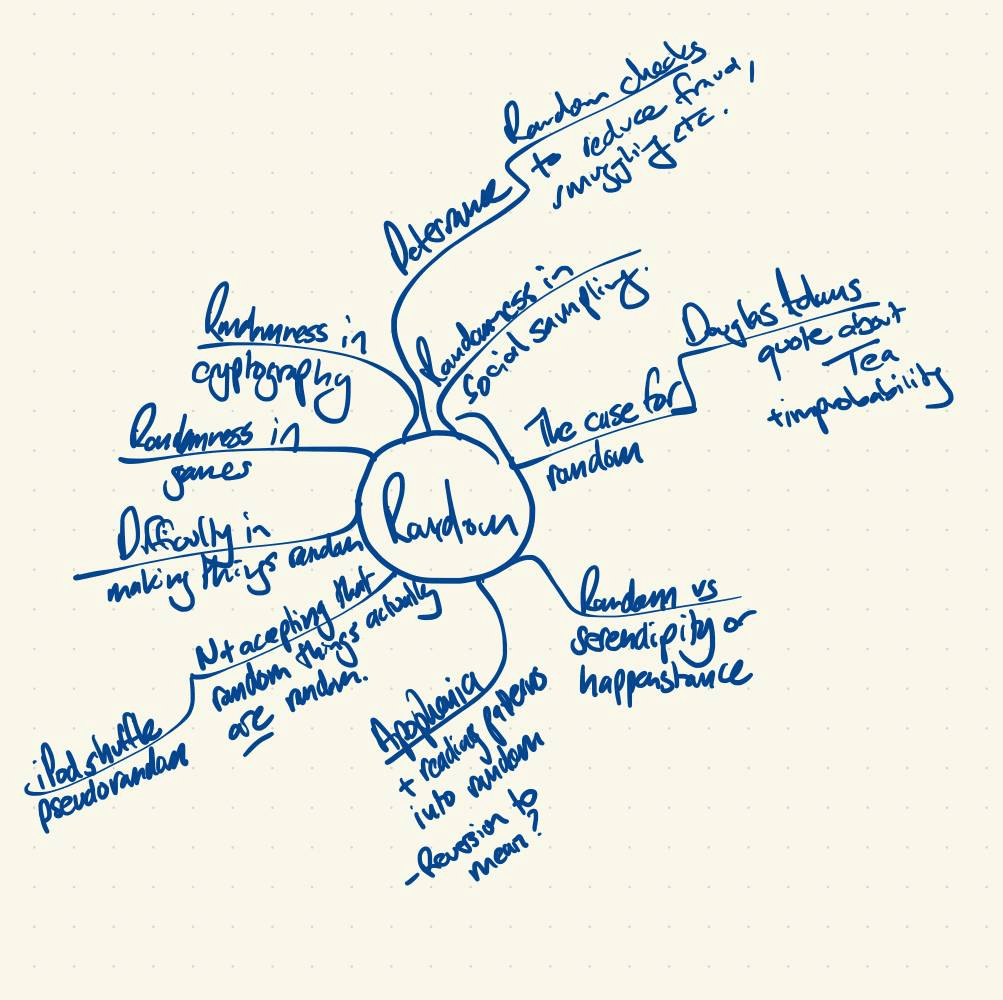
Specifically, an open question to my connections on the platform about examples of where randomness might be important. That gave me enough information alongside my own understanding of the field to create an outline content structure – essentially a first cut of a chapter plan.
At the end of May I also contacted Nick to see if he would be up for collaborating on this. I’m extremely happy that he agreed. When I tried writing the book about play I, in hindsight, desperately missed a co-author.
Automated help
We then started to plan. At a early stage, after sharing some ideas between us, I took a summary of what we though the chapters might look like and fed it into ChatGPT to get some ideas for things we might have missed. It was a useful exercise – there were a number of potential chapters that spurted out of the machine, but we figured that most of them would be subject matter we would cover in the existing chapters. There was one chapter that we thought might need to be added.
I also used GPT to recommend some books that would be relevant to each of the chapters for background reading. That was really interesting; for the 8 main chapters with 3 books recommended for each, it generated valuable suggestions for 22 titles. It also gave 2 suggestions where it muddled the author and title, but this was a way better hit rate than I expected.
Finally at this stage I used GPT to help finish a first draft of a book proposal that could be shared with people in the publishing world. I really hate writing about me, even more so in a positive, “selling myself” kind of way. Having the machine do at least a first draft was both invaluable as well as quick.
The Speakery Canvas
I also had a bit of a brainwave at this point as to how to give Nick and me a structure within which to guide our planning conversations. We are both “rabbit holers” – we are ready and able to go down deep tangents at the drop of a hat. So we needed structure to keep us progressing.
The solution? Marcus Brown’s wonderful Speakery Presentation Canvas. It’s a tool designed for creating keynote speeches, but I figured it also gave a structure to think both about an audience and a narrative. Nick was sceptical at first, but after our first hour-long chapter planning session we were both convinced it could work. It also gives us a side benefit that we have the bare bones for a keynote presentation for each of the chapters, and that might become a possibility a bit down the line.
Breaking some rules
The plan was to spend one hour planning each chapter. Creating a core narrative and identifying both personal and external stories to illuminate our points.
A few other things came up along the way.
Non-linear
I’m a big fan of living the values which you are trying to espouse. As such we decided that the book should be able to be read either in a traditional linear way, or that each chapter would be self-contained in such a way that a reader could choose for a randomized sequence of chapters.
In effect this means that there are in order of 40,000 ways in which the book can be consumed (we are assuming that the introduction and conclusion chapters will be read first and last respectively in all cases).
Building things
Along the way we also decided that it might be fun to build a randomness generator which in turn could then be the machine which would allocate intrepid readers with their own random chapter list.
My shopping list currently consists of 8 miniature solar-powered maneki-neko, a webcam and a Raspberry Pi. We’ll see if it is really fun or not during the writing of the book.
A structure in which to work
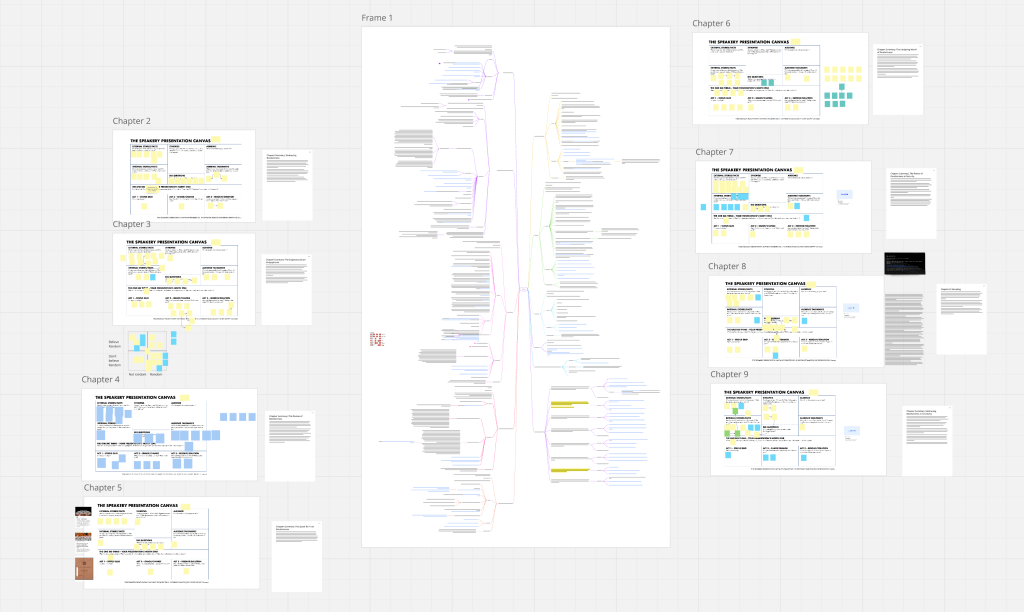
So after a number of sessions, and some reading around the topics in the meantime, we have a canvas for each of the eight main chapters, and a stack of ideas to explore, books to read, and people with whom to talk.
By the end of the week we’ll publish our chapter summaries as we’d love to get feedback on the plan as it stands, as well as ideas and pointers for interviewees.
 Random the Book
Leave a comment